Sunday, March 22, 2020

Puebla. La Casa del Dean murals Introduction.


The Casa del Deán in Puebla, Mexico, is one of few surviving sixteenth century residences in the Americas, built in 1580 by Tomás de la Plaza, the Dean of the Cathedral.  A devoted and learned man with sympathy for indigenous cultures gained during his years as a parish priest in Oaxaca, Tomás de la Plaza played a leading role in the planning and design of Puebla Cathedral.
   After completing his mansion across from the cathedral—its elegant purista facade was also designed by Francisco Becerra, the noted Spanish architect of the cathedral— in 1584 Tomás de la Plaza assumed additional debt in order to commission the extensive murals, only a fraction of which now survive.
   Although much of the house was tragically demolished in recent times, two of the upper rooms remain, along with their magnificent frescoes. 
   Their rediscovery and narrow escape from destruction in the 1950s and most recent restoration in 2010 revealed visionary works of art that rival European frescoes of the early Renaissance, while incorporating numerous native elements that identify them with indigenous visual traditions. 
   As we shall see, although not monastic murals, some of their content and their graphic style is related to other early monastery murals.
   

Sybils
1. Synagoga 2. Erythraea 3. Samia 4. Persica 5. Europa!  6. (Plaza Coat of Arms) 7. Cumaea 8. (Shell Niche) 9. Tiburtina 10. Cumana 11. Delphica 12. Hellespontica 13. Phrygia 14. (Coat of Arms) 15. Libyca

Triumphs
16. Love   17. Chastity  18. Time


19. (Wild Man?) 20. Death  21. Eternity 

22. Salon Three mural

The Murals
These masterful frescoes, although based firmly in Renaissance works derived from classical antiquity as are all  monastic murals, are nevertheless entirely the work of one or more native tlacuilos or elite artists, most likely trained in nearby Huejotzingo, whose outstanding native school was founded by Franciscan pioneer Juan de Alameda. 
   The murals, now in remarkably good condition considering their hazardous history, are contained in the two principal rooms, with some fragments in a third chamber. Both rooms are lined with large, colorful narrative murals on related but distinct themes, largely unique in Mexican mural art—one devoted to the Sybils, and the other to Triumphs.

Our next post will review the Sybils.


text © 2020 Richard D. Perry.  
 images © Juan Carlos Varillas and Niccolo Brooker. 
principal source: La Casa del Dean...New World Imagery in a Sixteenth-Century Mexican Mural Cycle Penny C. Morrill. 2014. U. of Texas Press 

Sunday, March 15, 2020

Yucatán: San Bernabé Ixil


The church at San Bernabé Ixil is a virtual twin to its neighbor at Cholul. As at Cholul, the rugged 17th century church was grafted onto a 16th century open chapel, which is now the sanctuary.
The facade was reworked in more recent times with the addition of the two belfries. The limestone relief of the patron St Barnabas holding a cross and the Gospel of St Matthew is the notable surviving colonial remnant in the church front.
Like Cholul too, Ixil retains sections of polychrome murals around both the sanctuary arch and the apse, most likely dating from the late 1700s.  Although unsophisticated in their draftsmanship, they are richly colored in varying shades of red, blue and orange.
Above the archway,  between the folds of a framing, rust red curtain, the figure of St. Barnabus, the patron saint, is flanked by floral urns and two heraldic angels perched on clouds playing horns.

 
In the apse, God the Father looks down from the painted vault, and at the rear, another pair of angels on clouds hold ribbons inscribed Oración (Prayer) and Silencio (Silence). The figures are complemented with passages of elaborate floral decoration and polychrome friezes.
     
Another striking mural, on the nave ceiling, depicts a cross with the Host and a dove set above a globe encircled by a serpent.
text © 2020 Richard D. Perry
images by the author and © Niccolò Brooker. all rights reserved

Sunday, January 5, 2020

Cuitzeo: Nativity with The Three Kings

In accordance with our usual custom we dedicate our first post of the year to a Nativity scene with the Three Kings.  This year we look at a mural in the upper cloister of the great Augustinian priory of Cuitzeo, in northern Michoacán—whose murals are among the outstanding colonial art treasures of this recently restored church and convento.
   As noted this mural is one of the few surviving frescoes located in the lunettes above the doorways in the upper cloister. All are painted in warm grisaille tones with red, gold and turquoise accents. 
Although in less than pristine condition the mural has been partially restored to clarify some details: Mary holds the infant Jesus at right accompanied by a standing Joseph in a bowler hat, as the Three Kings kneel or stand in front bearing their gifts.
 
A distinctive outcropping, perhaps a local geographical landmark, is shown to their left.
text © 2020 Richard D. Perry
images courtesy of Robert Jackson & Niccolo Brooker

Wednesday, November 6, 2019

Murals of Michoacán. Santiago Copándaro

 Shortly after construction began on the great priory at Cuitzeo, The Augustinians established the visita of Copándaro across the lake, to serve as a house of retreat as well as a way station for travelers journeying north from the capital at Morelia.
Laid out in the 1560s by Fray Gerónimo de la Magdalena, the architect of Cuitzeo, this little gem of a mission is a Plateresque showplace, likened by the Augustinian chronicler Diego de Basalenque to “a beautifully worked silver goblet.”
The Church
Although finely sculpted throughout, the church retains little of its early mural ornament. Traces of delicately drawn and colored grotesque friezes run along the nave and into the baptistry, weaving angels, serpents and religious insignia into a sinuous matrix of foliage.  
The Convento
The principal surviving fresco at Copándaro, at the north end of the arcaded portería, depicts the Spiritual Lineage of St Augustine. 
   In poor condition and partially erased, the mural is broadly similar to those at nearby Charo and at Atlatlahucan in Morelos, although closer in form to the Tree of Jesse model followed for other such murals, as at Zinacantepec. 
   The tree sprouts from the recumbent figure of the founder, the latter largely obliterated by the intrusion of a later doorway and now only identifiable by his disembodied episcopal miter. 
Rendered in a blue gray monochrome without the customary color, the mural portrays kings, nuns and martyrs of the Order perched on the spreading branches amid a variety of leaves , fruits, buds and blossoms.
In contrast, a partial Coronation of the Virgin at the other end of the portería glows with color. The Virgin rises through the clouds, escorted by angels, detailed in tones of blue and chestnut red.
  
The Cloister
Painted barrel vaults, crisscrossed by red ribs and blue, floating angel heads, cover the cloister walks.   Modern painted frames and friezes overlie and coexist with older friezes.
A few large narrative wall murals depict various scenes including what may be an Arrival of the Augustinian friars in the New World headed by St Augustine. Much overpainted at different times, it is difficult to discern or date the originals of these, if any, although the themes suggest an early colonial date.
  
Two other cloister murals of interest appear in the corner niches and lunettes at the end of the corridors. Of later colonial date, although possibly repainted, they are more folkloric in style and rendered in a variety of muted colors.
The principal mural portrays Christ at the Column, gesturing towards a kneeling St Peter. An inscribed ribbon reads, Conversus Dominus respexit Petrum— “the Lord turned and looked at Peter"
St Michael, resplendent in blues, red and eater tones, occupies another niche.  
A crowded Via Crucis appears in the lunette above. A fallen but unperturbed Christ hefts the reddish brown cross accompanied by the traditional cast with peasant like faces and a mule.
In another lunette, is a dramatic scene of Abraham and Isaac in similar style and coloration.
text © 2019 by Richard D. Perry.  mural images by Niccolo Brooker

Friday, October 18, 2019

The Triumph of the Church: Rubens and Mexico

Previously we looked briefly at a series of grand colonial Mexican paintings depicting the Triumph of the Church, including those in the cathedrals of Oaxaca and Puebla (see below)  In this post we look at their principal European source: a painting by the influential Flemish artist, Peter Paul Rubens. 
   In 1626 Rubens completed one of the most important commissions of his lifetime, a suite of finished oil sketches referred to as the Triumph of the Eucharist series. The panels were commissioned by the Infanta Clara Eugenia, ruler of the Southern Netherlands and a member of the Spanish royal family, as studies for a suite of sumptuous tapestries to be hung in the Claras Descalzas Reales monastery in Madrid. 
   Although Rubens used the paintings as preparatory to his tapestry designs, they are exquisite works of art in their own right. The largest and best known of these compositions—one that has been copied or used as a basis for numerous other paintings including several in Mexico—is commonly known as The Triumph of the Church.

In the spirit of the Counter Reformation, Rubens conceived the theme as an affirmation of papal authority, framed pictorially as a Roman triumph.

The Church (Ecclesia), dressed in papal vestments, sits in an ornate gilded chariot, holding up a monstrance with the shining Host. An angel behind her is placing the triple Papal tiara on her head.
The chariot is drawn by three fine steeds ridden by angels carrying the symbols of victory (palms and laurel wreaths) Others blow horns. The horses are led by three figures in flowing robes, thought to represent the three Theological Virtues (Faith, Hope and Charity)  or perhaps three of the four Cardinal Virtues of justice, prudence, temperance, and fortitude.
The lead angel on the white horse raises a canopy sheltering the silver and gold keys of St. Peter. 

The chariot wheels, encrusted with gems, crush the enemies of the Church in the form of sins, including one with a Medusa like hair (Envy) Two other figures, one blind and the other with asses’ ears (Blindness and Ignorance) stumble beside it.
The globe at the foot of the composition, ringed by a serpent eating its tail, symbolizes the eternal dominion of the Church.  The accompanying rudder, palm frond and oak branch, signify good government, victory and fortitude.
The Rubens paintings have been recently restored and have been exhibited in the Prado alongside some of the tapestries for which they were designed.
...........................................
Several versions of this theme by prominent colonial Mexican painters are modeled on the Rubens composition, although they vary in detail and fidelity, and are occasionally reversed:
The Triumph of the Church and the Eucharist
by Baltazar de Echave Rioja (1675)  in Puebla Cathedral.
The Triumph of the Church and the Sacrament 
by Marcial de Santaella (1735) in Oaxaca cathedral
The Triumph of the Eucharist (detail)  by Cristóbal de Villalpando (1684-5)
(Museo Regional de Guadalajara)
The Triumph of the Church and the Eucharist by Pascual Pérez
(Templo de Nuestra Señora de la Candelaria y de Guadalupe, Xonaca. Puebla)
text © 2019 Richard D. Perry
See our other posts on Santaella, Pascual Pérez and Villalpando

Monday, October 7, 2019

San Sebastian in Mexican art 1.

This is the first of two posts on portrayals of St. Sebastian in Mexican colonial art. This post focuses mainly on depictions of the saint in early mural art. 
   Reportedly a Roman officer sentenced to be executed by arrows during the Christian persecutions of the Emperor Diocletian in the fourth century, this early Christian saint and martyr, is popularly depicted in Christian art, and also commonly features in Mexican colonial painting and sculpture.
Cholula
He is customarily portrayed as a young man tied almost naked to a post or tree, often with one arm upraised, and transfixed by arrows, often accompanied by the bowmen.
   In Mexico, Sebastian was seen as a protector against the plague, and his popularity may also relate in part to his visual connection with traditional Aztec arrow sacrifice (tlacacaliztli). He was also prominent among the patron saints of Puebla.
   The saint is depicted in a number of early, largely 16th century murals in monastery precincts, of which we display a selection below:
Culhuacan
Metepec

 
Oxtoticpac                    Tepeyanco
Tepeapulco
Tepeji del Rio
Tula
Zinacantepec
Portraits of St Sebastian continued later into the colonial period, some in traditional style but others more stylized, some reflecting underlying homoerotic sentiments and taste.
by Miguel de Mendoza (San Cristóbal Suchixtlahuaca)
Our second post, which deals with the depiction of the saint in sculptural images will be found on our sister blog.
text © 2019 Richard D. Perry
color images by the author, Niccolo Brooker and online sources

Wednesday, September 25, 2019

San Gabriel Cholula: two more early frescoes

In earlier posts on the exceptional murals at San Gabriel Cholula, we highlighted scenes from the life of St. Francis and a large Mass of St Gregory. Here we look at two other early frescoes of interest.
The Annunciation mural
The first is a fine, early triptych portraying the Annunciation, now located in an office on the second floor of the convento. 

Flanked by separate portraits of St. Francis and St. Anthony, the Virgin Mary, seated with an open book, receives the doves of the Holy Spirit, as the archangel Gabriel gestures towards Heaven—the only portrayal of its patron saint in the monastery to our knowledge. An urn of lilies, symbolizing her purity, stands prominently between the two.
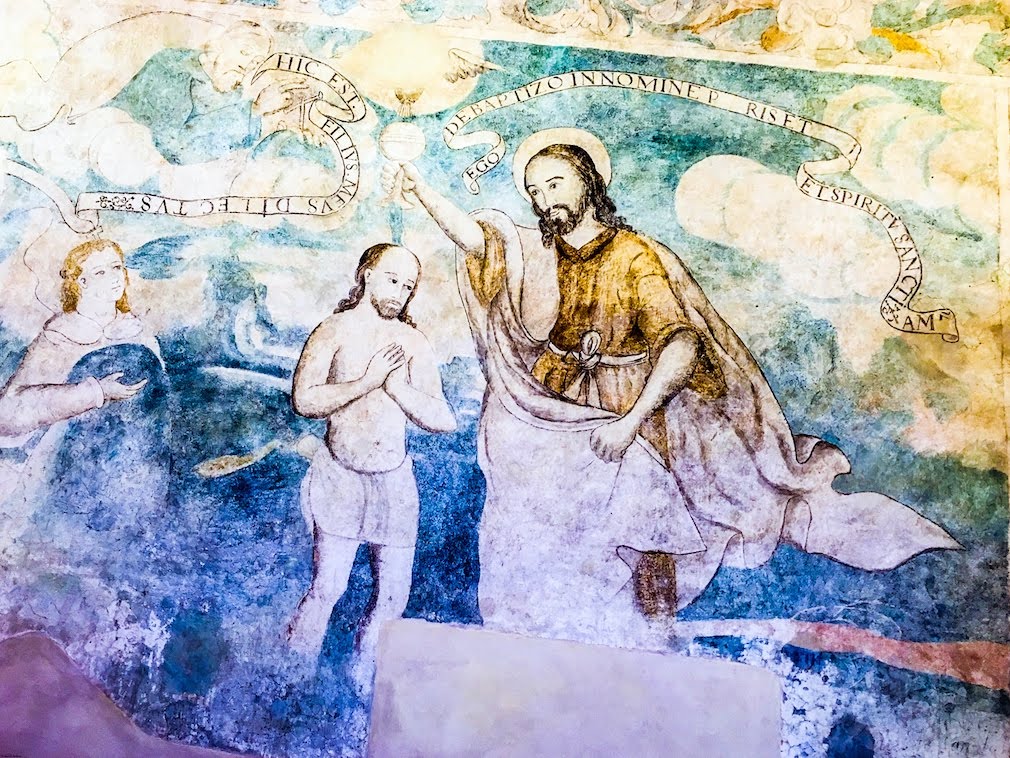
The Baptism of Christ
The second fresco, a colorful Baptism of Christ is located in the old portal de peregrinos, now the Franciscan library, and was uncovered where the baptismal font may have been located during the early years of the evangelization. 
   A long Latin inscription unfolds in the ribbon above John the Baptist, who raises the baptismal chalice above the almost naked Christ. God the Father speaks from the clouds—"this is my beloved son in whom I am well pleased." 
   After restoration, its bright range of color, including putative Maya Blue, has reemerged.
text © 2019 Richard D. Perry
color images courtesy of Robert Jackson