Friday, July 5, 2019

San Juan Evangelista Culhuacan: The Convento Murals 1

The Culhuacan map of 1580 by Pedro de San Agustín, with church and place glyph of sacred mountain with cave and spring.

The rugged Augustinian monastery at Culhuacan is hewn from coarse black lava. The roofless basilican church and its brooding convento convey the same timeless monumentality as the surviving Aztec structures scattered throughout the valley. The complex has undergone structural changes over the centuries—the old church collapsed and a new one built late in the colonial period.

Although some were lost to the reconstruction, neglect and ill considered, later over painting, and while many remain only fragmentary, the bleak convento is brightened by numerous 16th century frescoes in a mixture of styles and coloration. Executed al temple, or in fresco de secco— paint applied to dry instead of wet plaster—they picture a wide range of themes dear to the Augustinian Order.

Anteporteria
Beyond the L-shaped porteria, the vestibule (anteporteria) is decorated with a faded Ship of Friars mural thought to depict the arrival of the Augustinians in the New World. The murals in this room are painted in traditional warm black, with faded blue and umber details. 
The principal fresco, framed by painted baluster columns, is a triptych of a stylized St. Augustine, with crozier and miter, holding up the church, and depicted as Protector of his Order. He is flanked by black clad friars on either side beneath his spreading cloak, and in a reference to the other mendicant Orders, St Dominic stands to one side and St Francis receives the Stigmata on the right.
St Dominic
The Lower Cloister 

Thebaida with Calvary scene above arch 
The lower cloister murals are framed in the same style, but rendered in still glowing colors against an unusually bright azure background, possibly water related. 
   At least two of the walls depict the Augustinian Thebaida, or Allegory of the Eremitic Life— portrayed here as an Earthly Paradise. Against an idyllic landscape of rocks, hermits’ caves, lakes and native vegetation, groups of tiny friars pursue their tasks in a peaceable kingdom of naively drawn felines, rabbits and deer. 
More than merely decorative, the landscape mirrors the topography of the area as portrayed in the Culhuacan map, notably the distinctive local mount of Cerro de la Estrella with its cave and springs, sacred to the ancient Culhuas and the Aztecs as the site of the annual New Fire ceremony.  
   In fact, the Thebaida artist and the painter of the 1580 map (see above) may have been one and the same—possibly one Pedro de San Agustín, an elite tlacuilo from Tlatelolco and thus one of the few native muralists whose name has come down to us. 
   These large scale frescoes, which may have originally covered all of the cloister walls, are again framed by ornate, faux baluster columns and inset with medallions showing scenes from Christ’s Passion—an impressive and colorful gallery.  

Detailed and colorful grotesque friezes above the murals add to the intensity of the display. Numerous apostles, evangelists, saints and martyrs appear in large cartouches throughout— predominantly in blues, reds and earth hues— set in a matrix of foliage, angels and pegasi:
St. Augustine                                           St. Mary Magdalene 
St. James Major                                                                Martyr. Nicholas of Tolentino? 
St Lawrence                                              St Sebastian
By the stairwell, an enigmatic mural shows two friars—one reading a book and the other gazing up the stairs in an attitude of prayer. Birds fly above, with a steep hill behind. 
text ©2019 Richard D. Perry.
images by the author, Niccolo Brooker, Diana Roberts & Robert Jackson

Sunday, June 2, 2019

HUATLATLAUCA: The convento murals 2


The Upper Cloister
Passion scenes continue on the second level, with The Agony in the Garden, Christ at the Column, an Ecce Homo, a Road to Calvary and, once again The Crucifixion and The Resurrection. 
Road to Calvary
Ecce homo


Triumph of Death mural: Spaniards and natives 
A unique mural over the doorway strikes a darker note. Known as The Triumph of Death, this fresco depicts a giant, largely skeletal figure advancing with bow and arrow on a huddled group of startled and terrified sinners: lay figures and clergy, Spaniards and indigenous alike— a broad representation of 16th century colonial society. 
Related to the Grim Reaper mural at Malinalco, this is the sole Death figure to be portrayed with bow and arrow in early Mexican mural painting, aside from a smaller figure at Culhuacan. 
Beyond the figure of Death rises a mountain with a cave, a significant local topographical feature and at his feet, a traditional, woven palm basket.The red and orange tones of Death contrast with the vivid blue landscape behind—a hue now identified as Maya blue. 
On the opposite (north) wall is a complementary composition, possibly a partial Thebaida—an exclusively Augustinian theme. An Augustinian friar preaches, arms uplifted, to gathered knots of friars in a leafy blue and ocher landscape. Behind him is a large outcropping—another local landmark.
Elegant frames of painted Plateresque pilasters and large polychrome friezes border the murals, some with more Augustinian portraits entwined with angels and birds amid swirls of native foliage.
text © 2019 Richard D. Perry. 
images by the author, Niccolo Brooker and Robert Jackson

Friday, May 24, 2019

HUATLATLAUCA: The convento murals 1


HUATLATLAUCA, the monastery front
Located in the Atlixco valley of southern Puebla state, this ancient community, whose name means "Place of the Red Eagle,” is the site of a little known but fascinating 16th century monastery, noted for its rich tequitqui carving. 
   Founded around 1550 by the Franciscan Order, who began work on the church, the monastery was later ceded to the Augustinians, who added the convento, with its colorful murals, in the 1570s—one of the last Augustinian mural programs. 
The Porteria
The church is flanked on the left by the former open chapel, currently blocked up, while the convento to the right is fronted by a long arcaded portería. 
Little remains of the murals that formerly lined its walls. On the south side, a fragment shows The Virgin and Child with a kneeling St Francis—the only heritage mural from the Franciscan era—and sections of a blue frieze with putti battling fantastic pegasus creatures!

The Cloister Murals
Recently restored, the peaceful cloister is simply enclosed by broad stone arcades set on bulbous Plateresque columns. Both the upper and lower cloister walks are lined with late 16th century frescoes and friezes.

The Lower Cloister
Here we find the greatest variety and quality. Although faded, the corner niches depict key scenes from the life of Christ: The Nativity, The Crucifixion and The Resurrection, rendered in a serene Renaissance style with muted blues and reds and framed by extensive friezes and festooned columns.
 
The Crucifixion fresco, although in much need of restoration, reveals fine draftsmanship as well as variety of color—orange, burgundy and turquoise. Friars and bishops kneel before a crucifix? in a cartouche of the complex frieze above. In the Resurrection, the risen Christ stands triumphant above an opened tomb, flanked by astonished onlookers.
In the fourth corner is an unexpected joint portrait of the two other Mendicant founders, St. Dominic and St. Francis, upholding the church. 
And another large corner mural, beside the Nativity, shows St Augustine as Protector of the Order, sheltering friars beneath his ample cloak, rendered in vivid tones of red, orange, blue and black. Over a center archway, the saint is portrayed with the child Jesus.
   But the main group of frescoes on the lower level, along the walks and between the arches of the cloister arcades, comprises numerous portraits of Augustinian saints and martyrs, famous and obscure alike—the most complete surviving gallery of Augustinian mural portraits in Mexico, although some are only partial.
 
Prominent figures include St. Thomas of Villanueva, William of Aquitaine, St. Boniface, Nicholas of Tolentino and St. Mónica. Others portray the Augustinian desert fathers or African martyrs as well some of the English martyrs. All are identified by at least partial inscriptions.
In our next post we look at the upper cloister murals.
text © 2019 Richard D. Perry. 
images by the author, Niccolo Brooker and Robert Jackson

Sunday, May 19, 2019

Tezontepec. The Cloister Murals Part 2.

The Upper Cloister
Following on the early life of Christ in the lower cloister, a sequence of eight Passion scenes continues clockwise around the upper level, again executed on a large scale and brightly colored although some are better preserved than others. 
   The cycle begins with the Agony in the Garden above the entry to the stairwell, and continues with the Betrayal by Judas or Taking of Christ; Jesus in the House of Ananias (Caiaphas?) The Flagellation; The Mocking of Jesus (Crown of Thorns); The Judgment of Pilate; The Via Crucis, and ends with the Crucifixion in the northeast corner. !
Judas’ Betrayal of Jesus
Via Crucis or Road to Calvary

 
Veronica (Via Crucis detail)
Jesus before Caiaphas
The Judgment of Pilate
The Crucifixion
Also of interest are the monochrome friezes that run along the sides of the long, narrow ambulatory on the south side of the upper cloister and its northerly extension extending into the adjacent cells.
   On the east/west corridor, a running grotesque frieze incorporates framed roundels that constitute an extensive portrait gallery of Augustinian saints and martyrs, including St. Augustine, St. Nicholas of Tolentino, and St. Monica. 
St Augustine with miter and crozier upholding the church
John of Sahagun; St William the Hermit; 
Bishop John the Good; Nicholas of Tolentino; 
St Monica; St Felicity.
 
St Andrew; St James Minor, 
St Peter; St Philip; 
John the Evangelist; St Matthew.
The Twelve Apostles occupy the larger medallions along the extension: !
At one end of the corridor a sepia monochrome fresco in the lunette depicts a Resurrection scene crowded with Roman soldiers toppling away from the triumphant Christ. 
Several other devotional murals continue in the adjacent friars’ cells including the Prior’s room. These also depict Passion themes with a Crucifixion. Saints Peter & Paul flank the doorway below the frieze.
text © 2019 Richard D. Perry
images by the author, Niccolo Brooker and Robert Jackson.

Monday, May 13, 2019

TEZONTEPEC: The Cloister Murals Part 1.

San Pedro Tezontepec, also known as Villa Tezontepec, is a hilltop Otomi village southwest of Epazoyucan, Hidalgo, of which it was originally a visita.
Standing inside the battlemented atrium with its four surviving corner posas, the Augustinian monastery comprises a rather plain 17th century church and an earlier convento with an arcaded, two story cloister. 
  
The church interior is unprepossessing, with few original furnishings aside from a venerable baptismal font beneath the choir carved with vine leaves and monograms.
The Murals
Although 16th century murals once covered almost every space in the convento, due to the repurposing of several important conventual rooms including the porteria, anteporteria and sacristy, almost all of the surviving visible murals are now found in the cloister.
   Beneath painted vaults of meandering ribs with floral bosses and bands of decorative friezes filled with grotesque decoration, inscriptions and roundels of Augustinian saints and insignia, the cloister walks and pillars of the arcades are a gallery of large narrative murals, mostly outsize portraits of Augustinian luminaries. 
portraits of saints along the cloister walk
Although in varied condition, all are framed by extravagant Plateresque borders colored in a bright palette of blue, green and earth colors. 
   But the principal attraction here is a cycle of polychrome frescoes illustrating the Life and Passion of Christ—among most complete to be found in any Mexican monastery. Derived from a Flemish or northern European print source, the compositions and figures are confidently drawn in sweeping strokes, whose vigor combines with subtlety in gesture and facial expression. 
   Color is applied in large background washes and to specific details—a later addition to the original grisaille treatment.
The Lower Cloister
Four pivotal scenes from the early life of Jesus unfold in the corner niches, starting in the northwest corner with a simple Nativity. The Adoration of the Magi follows, then the Presentation in the Temple and lastly, the Flight into Egypt. 
Clockwise from top left: The Nativity; Flight into Egypt; Magi; Presentation.
The Stairway
Along with a painted balustrade, fragments of wooded landscapes with jagged hills, alive with birds and butterflies, cling to the side of the stairwell, probable remnants of a customary Augustinian Thebaida tableau. 
   Fish swim amid blue waves in the lower sections—suggesting an earthly paradise rather than the arid Egyptian desert of tradition.
text © 2019 Richard D. Perry
images by the author, Niccolo Brooker and Robert Jackson.

Monday, May 6, 2019

San Vicente de Ferrer Chimalhuacan: the cloister frescoes

This little jewel of a monastery was one of the first Dominican missions to be founded in the Valley of Mexico. Its principal attraction is its exquisite, intricately carved Isabelline/mudéjar church doorway
The formerly abandoned cloister was recently given a facelift, and the walks are mostly whitewashed. Vestiges remain of mural fragments, largely friezes and inscriptions above the doorways and the gray basalt arcades.
 
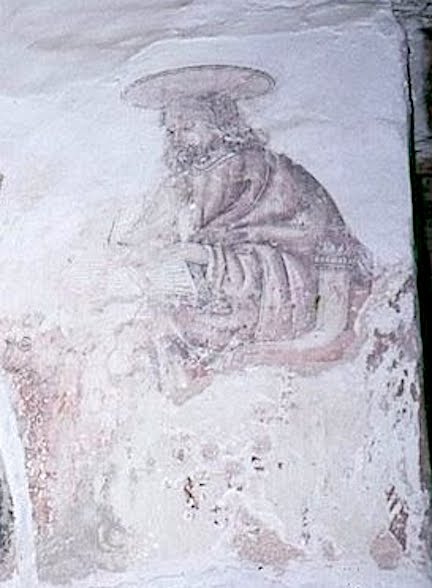
Sts Mark and Luke
Some surviving figures include richly robed and haloed Evangelists sitting on elaborate thrones. These are finely drawn with added red and ocher washes.
  
One unusual fresco is a partial Expulsion from the Garden, depicting an agitated God the Father and the Tree of Knowledge on one side of the arch, and Adam and Eve in retreat, hastily covering their private parts, on the other. To our knowledge this is the only representation of this biblical event in any Dominican mural.
text © 2019 Richard D. Perry
images by the author

Saturday, April 27, 2019

Ixmiquilpan: The Friezes

Last year we ran an extended series on the murals of Ixmiquilpan.
Ixmiquilpan, the upper nave frieze, detail
The Church Frieze
While most commentary on the murals has been focused on the Battle scenes along the nave of the church, which take the form of a giant frieze, another less noted frieze runs around the nave at the roofline, using the same basic design and coloration, as well as some of the same imagery as the battle frieze, with medallions that include warriors, centaurs and other mythical beasts, framed by acanthus foliage. 
   Because of its height, uneven condition, and lacking the scale, narrative drama and vivid detail of the lower frieze, its effect is dulled. And perhaps because of this, unlike the battle friezes below, the upper frieze was never whitewashed and is unaltered.
Several other friezes embellish the church and convento. 
Sacristy frieze with medallion of the Agony in the Garden
The Sacristy Frieze
In the sacristy, as in the church, an upper frieze mirrors the narrative frescoes on the walls below, depicting Passion scenes and portraits of saints in the same style but set in medallions within a matrix of foliage and ornamental strapwork.
Monochrome foliated friezes survive around the cloisters and stairwell framing escutcheons of religious and Augustinian insignia in a parade of exotic beasts, including dolphins, peacocks and pegases. 
 
See our earlier posts on the convento murals of Ixmiquilpan: The Sacristy; Last Judgment
text © 2018 Richard D. Perry 
color images by Niccolo Brooker and Benjamin Arredondo