Tuesday, October 30, 2018

José Joaquín Magón, pintor poblano: El Carmen 2

As noted in our previous post, several cycles of paintings by Magón are found in the city Carmelite church of El Carmen and its chapels, including Passion scenes and a sequence on the life of St. John of the Cross, another Carmelite co-founder.
The Divine Prisoner or the Flagellation of Christ
The Last Supper (detail)
The Agony in the Garden with portrait of Magón patron Bishop Abreu
The Crucifixion
These Passion scenes are located in the former chapel of Santa Teresa, now El Santo Niño de Praga, at El Carmen. The next cycle depicting key scenes from the life of St. John of the Cross hangs in the eponymous chapel dedicated to the saint.
John of the Cross taking the Carmelite habit
 
The miracle of the Hat;                     St John celebrating Mass;
  
St John and the Demons;                       The Stigmatization of St John
Text © 2018 Richard D. Perry
color images from online sources

Thursday, October 25, 2018

José Joaquin Magón, pintor poblano: El Carmen 1.

In recent posts on this blog we have looked at colonial artists in the Puebla region, members of a distinctive school of painting, several of whom were of humble origins—either mixed race or from an indigenous background.
   These included Miguel de Mendoza, Gregorio José de Lara and Pascual Pérez, and demonstrate that racial or social prejudices often came second to talent in the artistic milieu. 
In this new series we consider the life and selected works of another notable pintor poblano of lowly origins and great accomplishment, José Joaquín Magón, also known as a poet. Sometimes referred to as a mulato, or Afro-Mestizo, he was a member of the mixed race “casta militia” known as El Regimiento de Pardos—whose membership was often a path to greater social acceptance for artisans and others of mixed race.

While other details of his life are sparse, we know that he was born in Puebla and was active as a painter between 1740 and 1763. His busy workshop was a training ground for other promising poblano painters. Although the majority of his paintings are found in the Puebla area, others are located further afield in Mexico and even Spain.
   Magón worked in a number of genres including the popular casta paintings of the period, but much of his oeuvre was under commission from the religious orders, most notably the Carmelites.

We start our series on Magón with his commissions for the Carmelite Order.

A majority of his paintings for the Carmelites rest in the Order's complex in the city of Puebla: El Protomonasterio de las Carmelitas Descalzas de San José y Santa Teresa, commonly known as El Carmen.  These include large works in praise of the Order and its co-founder St Teresa of Avila.
Puebla Cathedral sacristy
Entitled Allegory of the patronage of the Virgin and St. Joseph of the Carmelite monastery in Puebla it includes a portrait of the Bishop Pantaleón Álvarez Abreu (circled) a prominent patron of the artist.
Magón's large canvas portraying the Carmelite Doctors, martyrs and confessors hangs in the city parish church of El Sagrario.
Another vast panel glorifying the Order rests in the Carmelite church museum of San Angel in Mexico City. This painting includes portraits of the Old Testament prophets Elijah and Elisha, who by tradition appeared with St Teresa as spiritual founders of the Order—a tradition viewed as heretical by the Jesuits, the great rivals of the Carmelites, and others.*
   Several other cycles of paintings by Magón are found in the city Carmelite churches, including Passion scenes and a sequence on the life of St. John of the Cross, another Carmelite co-founder, which we look at in our next post.
   It should be noted that Magón's paintings relating to Carmelite history and personages were seen as a form of propaganda and may be viewed as creating an essential narrative for the Order in their struggle for legitimacy against the Jesuits and others.
text © 2018 Richard D. Perry
color images from internet sources
* This controversy and its role in the painter's work has been explored in the recent book, “El pincel de Elías, José Joaquín Magón y la orden de Nuestra Señora del Carmen” by the Mexican art historian Alejandro Andrade Campos.
Text © 2018 Richard D. Perry
color images from online sources

Saturday, October 13, 2018

Tochimilco: the Murals

The rugged hillside monastery of Asunción Tochimilco stands on the upper slopes of Popocatepetl, above Atlixco. The mission is noted for its impressive, black and white tezontle front, its historic open chapel and 16th century fountain. 
the lost mural of St Christopher
The Murals
Although overzealous repair work 
beside the open chapel in the 1960s destroyed a dramatic fresco of St. Christopher on the adjacent tower, other murals survive in the cloister. 
The lower cloister with exterior portraits 
All that remains of the cloister murals are two series of bust portraits of Franciscan saints and other notables that appear above the outer and inner arcades of the lower cloister. Although not identified by name those on the outer arcade appear to be post colonial in date. 
 
Outer arcade portraits
 
The Outer Arcades
Framed and linked by a dark red Franciscan knotted cord, portraits of various saints appear above the springing of each arch, female for the most part, shown with their traditional attributes. Although minimally protected by an overhanging cornice, the exterior murals have been recently restored to some extent, but remain exposed to the weather.
The Inner Arcades
The portraits above the inner arcades are contained in ornamental cartouches, are generally better preserved and may be earlier, probably later colonial. These busts, almost all of anonymous friars, are generic without much individual character.
   For the most part they are framed in curls of red and turquoise blue against an ocher background, and again, linked by the Franciscan cord above. 
   
The inner arcade portraits 


Similarly framed mural portraits of the archangels Michael and Raphael grace the sanctuary arch inside the church.
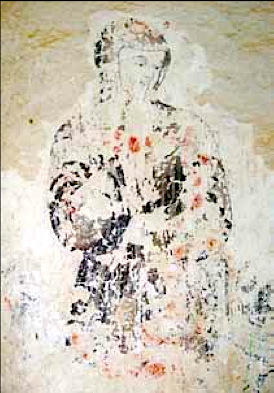
Only one other mural has survived and that is the barely recognizable figure in the convento anteporteria of a cowled nun with a finger to her lips. Painted in warm monochrome with red accents, she seems to urge silence upon the visitor to the convento.
text © 2018 Richard D. Perry
color images by Niccolò Brooker and others

Monday, October 8, 2018

Pazulco:The Baptistery Murals

In a companion post we looked at the main altarpiece in the church of Asuncion Pazulco.  Here we view the murals of the baptistery.
Although this painted room contains no clear scene of the Baptism of Christ as is customary, the surviving mural fragments include, apart from some rosettes, emblems of early Imperial Spain, notably the heraldic lions and castles and the Hapsburg two headed eagle.
the lions and castles of Isabelline Spain
Two headed Hapsburg imperial eagle with Augustinian pierced heart emblem
Angel of the Passion
text © 2018 Richard D. Perry
images courtesy of Niccolò Brooker

Wednesday, September 26, 2018

Gregorio José de Lara: A Vision of St. John on Patmos

In our last post we described a group of paintings by the 18th century Pueblan artist Gregorio Lara, that were recently rediscovered and restored, and are now on display in the museum of San Miguel Huejotzingo, Puebla. 
   Of possible Tlaxcalan origins, Gregorio José de Lara y Priego, to give him his putative full name, was active in the Puebla region during the mid-1700s. He ran a large studio and one of his students was the eminent poblano painter Miguel Jerónimo Zendejas, who was also his brother in law.
   Other signed works by Lara are in the sacristy of San Gabriel de Cholula, and six large canvases on the theme of the Passion are reputedly in the church of Santo Domingo de Puebla.

The focus of this post however, is another singular work by Lara, his Vision of St. John on Patmos, a signed painting now located in the Museo de la Basílica de Guadalupe in the city of Mexico but at one time thought to have hung in the Dominican church of San Juan Coixtlahuaca in the state of Oaxaca.
   In the foreground the youthful St. John the Evangelist, dressed in his traditional green with a red cloak, is seated with his symbolic eagle companion on the shore of the island of Patmos. An inkwell and manuscript lie on the ground in front of him. 
   As he recounts in his Book of Revelation, John looks up to witness a vision of the Woman of the Apocalypse:

“A great sign appeared in heaven: a Woman, clothed in the sun, with the moon under her feet, and a crown of twelve stars on her head…. Another sign appeared in the sky: a great red serpent, with seven heads and ten horns, on its head seven crowns. Its tail drags the third part of the stars of the sky and precipitated them on the earth…the Woman was given the two wings of the big eagle to fly to the desert, to its place, away from the Serpent”

In this painting, the scene is portrayed as described, although the Woman, often identified with the Virgin of the Immaculate Conception, is here depicted rather as the Virgin of Guadalupe—a uniquely Mexican portrayal.

text © 2018 Richard D. Perry

Wednesday, September 19, 2018

Gregorio José de Lara: St Francis at Huejotzingo

Restoration is under way at San Miguel Huejotzingo of six previously neglected canvases, painted in the 1740s by the noted poblano artist Gregorio José de Lara. Several of the paintings include the names of their patrons and one is signed by the artist.
    Abandoned and largely forgotten in a remote corner of the convento, these recently rescued works were in an advanced stage of deterioration, soiled over the centuries, patched, torn and rife with insect damage.
  
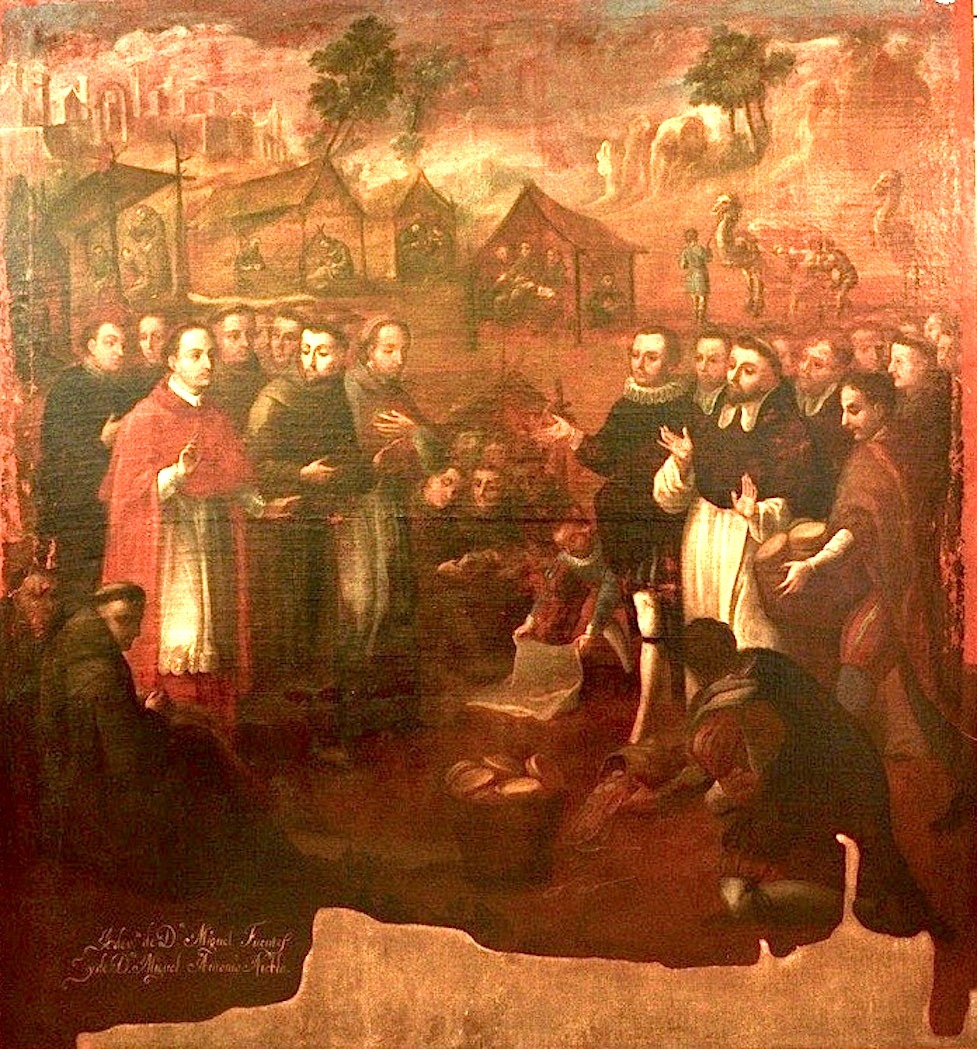
The paintings portray six lesser known and illustrated episodes in the life of St. Francis, including the Fiery Chariot;* Rescuing Souls from Purgatory; the Death, and the Transition of the saint, together with two other obscure scenes.
 
The Death, and Transition of St. Francis
  
St Francis, St Dominic and the loaves of bread;                 St Francis with a scourge;
Because of their large scale, measuring more than two meters in both dimensions, these paintings were not part of any altarpiece but instead designed to line the walls of the cloister or one of the conventual rooms. 
   The uncommon themes also suggest that they were intended for the private edification and contemplation of the friars themselves.

Full restoration of the six canvases is expected soon, following which they will be on display in the Museum of the Evangelization, housed in the former convento here at Huejotzingo.
* As it happens, another of the very few portrayals of this incident appears at Huejotzingo, in a 16th century mural of St. Francis located in the Sala de Profundis, also a private space for the friars.
text © 2018 Richard D. Perry
color images by Tacho Juarez Herrera
Look for our other posts on Huejotzingo: The Posa chapels; The Main Altarpiece; The North Doorway; The Talavera painting; The Church Murals; The Convento Murals;

Friday, September 14, 2018

The Tlaquiltenango codices

In an earlier post we reviewed the early Dominican murals painted at Tlaquiltenango. Another extraordinary survival there is a group of early colonial codices, painted in pre hispanic style, and found in the lower cloister, that are thought to date from the Franciscan occupation of the convento.
   Early in the 1900s, numerous fragments of several 16th century native codices inscribed on amate paper, were discovered pasted around the lower cloister some of them whitewashed and painted over as friezes. 
genealogy fragment
While some were sold and otherwise disposed of, study of the surviving pages determined that they were remnants of 15 early colonial documents. Originally painted in red, black and blue pigments, the codices dealt mostly with tribute lists and work assignments, although some contained genealogical and calendrical information.
tribute list
Aztec months
text © 2018 Richard D. Perry
graphic source: Laura Elena Hinojosa,
 Quince códices en la memoria de un convento Revista Ciencia 2017