Wednesday, September 26, 2018

Gregorio José de Lara: A Vision of St. John on Patmos

In our last post we described a group of paintings by the 18th century Pueblan artist Gregorio Lara, that were recently rediscovered and restored, and are now on display in the museum of San Miguel Huejotzingo, Puebla. 
   Of possible Tlaxcalan origins, Gregorio José de Lara y Priego, to give him his putative full name, was active in the Puebla region during the mid-1700s. He ran a large studio and one of his students was the eminent poblano painter Miguel Jerónimo Zendejas, who was also his brother in law.
   Other signed works by Lara are in the sacristy of San Gabriel de Cholula, and six large canvases on the theme of the Passion are reputedly in the church of Santo Domingo de Puebla.

The focus of this post however, is another singular work by Lara, his Vision of St. John on Patmos, a signed painting now located in the Museo de la Basílica de Guadalupe in the city of Mexico but at one time thought to have hung in the Dominican church of San Juan Coixtlahuaca in the state of Oaxaca.
   In the foreground the youthful St. John the Evangelist, dressed in his traditional green with a red cloak, is seated with his symbolic eagle companion on the shore of the island of Patmos. An inkwell and manuscript lie on the ground in front of him. 
   As he recounts in his Book of Revelation, John looks up to witness a vision of the Woman of the Apocalypse:

“A great sign appeared in heaven: a Woman, clothed in the sun, with the moon under her feet, and a crown of twelve stars on her head…. Another sign appeared in the sky: a great red serpent, with seven heads and ten horns, on its head seven crowns. Its tail drags the third part of the stars of the sky and precipitated them on the earth…the Woman was given the two wings of the big eagle to fly to the desert, to its place, away from the Serpent”

In this painting, the scene is portrayed as described, although the Woman, often identified with the Virgin of the Immaculate Conception, is here depicted rather as the Virgin of Guadalupe—a uniquely Mexican portrayal.

text © 2018 Richard D. Perry

Wednesday, September 19, 2018

Gregorio José de Lara: St Francis at Huejotzingo

Restoration is under way at San Miguel Huejotzingo of six previously neglected canvases, painted in the 1740s by the noted poblano artist Gregorio José de Lara. Several of the paintings include the names of their patrons and one is signed by the artist.
    Abandoned and largely forgotten in a remote corner of the convento, these recently rescued works were in an advanced stage of deterioration, soiled over the centuries, patched, torn and rife with insect damage.
  
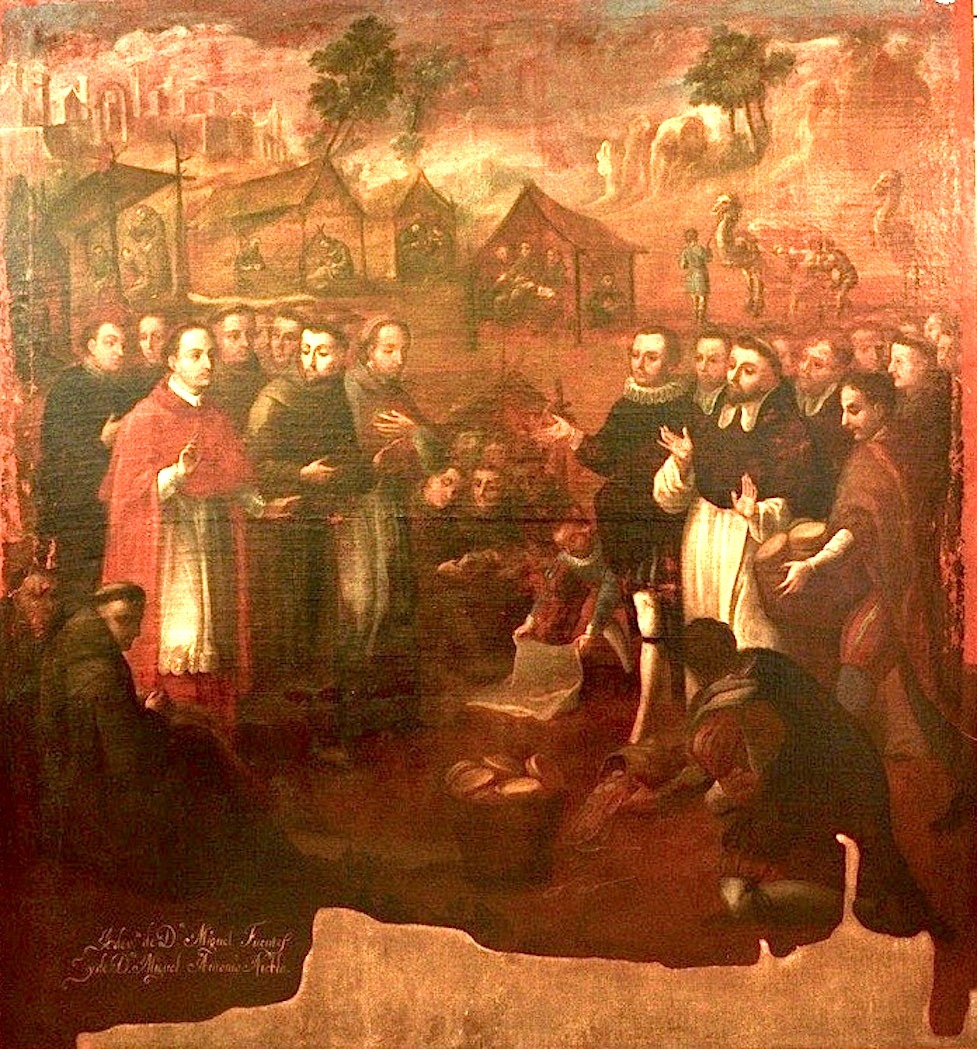
The paintings portray six lesser known and illustrated episodes in the life of St. Francis, including the Fiery Chariot;* Rescuing Souls from Purgatory; the Death, and the Transition of the saint, together with two other obscure scenes.
 
The Death, and Transition of St. Francis
  
St Francis, St Dominic and the loaves of bread;                 St Francis with a scourge;
Because of their large scale, measuring more than two meters in both dimensions, these paintings were not part of any altarpiece but instead designed to line the walls of the cloister or one of the conventual rooms. 
   The uncommon themes also suggest that they were intended for the private edification and contemplation of the friars themselves.

Full restoration of the six canvases is expected soon, following which they will be on display in the Museum of the Evangelization, housed in the former convento here at Huejotzingo.
* As it happens, another of the very few portrayals of this incident appears at Huejotzingo, in a 16th century mural of St. Francis located in the Sala de Profundis, also a private space for the friars.
text © 2018 Richard D. Perry
color images by Tacho Juarez Herrera
Look for our other posts on Huejotzingo: The Posa chapelsThe Main Altarpiece; The North DoorwayThe Talavera paintingThe Church MuralsThe Convento Murals;

Friday, September 14, 2018

The Tlaquiltenango codices

In an earlier post we reviewed the early Dominican murals painted at Tlaquiltenango. Another extraordinary survival there is a group of early colonial codices, painted in pre hispanic style, and found in the lower cloister, that are thought to date from the Franciscan occupation of the convento.
   Early in the 1900s, numerous fragments of several 16th century native codices inscribed on amate paper, were discovered pasted around the lower cloister some of them whitewashed and painted over as friezes. 
genealogy fragment
While some were sold and otherwise disposed of, study of the surviving pages determined that they were remnants of 15 early colonial documents. Originally painted in red, black and blue pigments, the codices dealt mostly with tribute lists and work assignments, although some contained genealogical and calendrical information.
tribute list
Aztec months
text © 2018 Richard D. Perry
graphic source: Laura Elena Hinojosa,
 Quince códices en la memoria de un convento Revista Ciencia 2017 

Sunday, September 9, 2018

Cuauhtinchan: a Tale of Two Altars

In an earlier post we looked at the main altarpiece at San Juan Bautista Cuauhtinchan.  Our interest here however is in a pair of thematically linked but contrasting retablos, both dedicated to the Franciscan saint San Diego de Alcalá. 
© Niccolo Brooker
The Wooden Altarpiece
We look first at the lateral wooden retablo of San Diego in the nave, thought to have been commissioned in the late 1500s, following the canonizing of the saint in 1588. This places it among the select company of Mexican retablos created in the 16th century. A dedicatory plaque in Latin may give the date.
Elegantly fashioned in the Renaissance/Mannerist style—much like the main retablo itself—the retablo is even more richly detailed.  
   Delicately carved reliefs of painted angels adorn the columns and frieze. The figure of the saint occupies the center niche, framed by fluted tritostyle columns and a broken classical pediment. Four lateral paintings illustrate key scenes from the life of San Diego.
The Painted Wall Retablo
In 1987, following earthquake damage and other deterioration of the altarpiece, it was dismounted for restoration, only to reveal an earlier, and previously unknown mural on the wall behind it, a painted retablo on the same subject—the life and miracles of San Diego de Alcalá.  

   The wall niche in the center, which once held a statue or image of the saint, is framed by six scenes of the miracles, several of them captioned in clear script.
 
In contrast to the sophisticated wooden altarpiece, the mural presents a more folkloric look—like other murals found at Cuauhtinchan, undoubtedly the work of indigenous artists. 
Its surprisingly broad range of still vivid color, due in part to its being hidden for 300 years, retain their freshness and directness of popular expression.
  
San Diego mural retablo 1                                                 mural retablo 2
Following much discussion on how to preserve the mural, it was decided to detach it from the wall and mount it on a fiberglass base for removal. It is now on display in the adjacent Museum of Religious Art at Cuauhtinchan along with other colonial art works including, as it happens, another retablo style mural with painted spiral columns.
text © 2018 Richard D. Perry. color images courtesy of Niccolo Brooker and ELTB

Source:  Carlos Flores Marini,  El retablo pintado de Cuauhtinchan  UNAM/INAH 2003

Sunday, September 2, 2018

Pascual Pérez: The Virgin of the Seven Joys

Several paintings by Pascal Perez are found on display in the prestigious Museum of Religious Art in the former Dominican convent of Santa Mónica in the city of Puebla.
   One of the most interesting of these is this portrait of the Virgin of the Seven Joys (Los Gozos), a later work of middling quality by Pérez, painted in 1715. 
Although the conventionally sweet faced virgin, pierced by seven arrows in imitation of her more common Seven Sorrows iconography, is generic in appearance, the figure in the lower right of the frame has more individual character. 
   It is in fact a closely observed portrait of the eminent patron of the painting, one Ignacio Asenjo y Crespo (1650- 1736), a canon of the cathedral and a close associate of the long serving bishop of Puebla and Tlaxcala, Manuel Fernández de Santa Cruz (1673 - 1699)  
   Asenjo y Crespo is best remembered for his persistent and successful promotion of the cult of Los Gozos in Puebla during the early 1700s, and the renovated, eponymous city chapel is one material result of his endeavors.
At least two other works by Pérez are on display in the Museo. One portrays a cloaked St. Luke with his bull writing his gospel in a large arcaded hall, overlooking cameo scenes of the Nativity and the Crucifixion.
St. Catherine of Siena is the subject of a second canvas. She stands in her Dominican habit clutching a cross before a skull and book on a table draped with a green cloth. A storm rages outside. 
Pascual Pérez, "El Mixtequito," was a prolific, leading light in the Pueblan school of painting, active in the later 1600s and early 1700s. His work covers a broad range of religious subjects and is found in churches and collections in the city of Puebla and its environs, including Cholula. His interment in Puebla cathedral attests to his regional prominence at his death in 1731.
text © 2018 Richard D. Perry.  
color images courtesy of Niccolò Brooker and Tacho Juárez Herrera
Visit our other pages on Pascual Pérez: San Andres CholulaSan Jose de PueblaEl Carmen; The Temptations of Christ;

Thursday, August 30, 2018

Pascual Pérez: The Triumph of the Church

We continue our series on the Pueblan painter Pascual Pérez with a look at one of his most ambitious and heroic works.
El Templo de Nuestra Señora de la Candelaria y de Guadalupe
Built by Tlaxcalan artisans between 1618 and 1642) the Temple of Nuestra Señora de la Candelaria y de Guadalupe is located in a colonial barrio of the city of Puebla. Orange painted towers flank its sober baroque facade, cut from gray stone in classic poblano style.
Several gilded altarpieces, fashioned in ornate late baroque style line the walls of the nave and side chapels, together with a number of large individual paintings of quality.
Our chief interest here is a large canvas, hung in the apse beside the main retablo, depicting the Triumph of the Church and Eucharist, currently attributed to Pascual Pérez.
   Based, like most Mexican versions of the theme, on the celebrated 1626 composition by Peter Paul Rubens, Pérez’ painting follows more closely the well known panel by Baltasar de Echave Rioja, completed in 1675 for the sacristy of Puebla cathedral—a work with which Pérez was surely familiar. 
Báltasar de Echave Rioja, Triumph of the Church. Puebla Cathedral
Pascual Pérez , "El Mixtequito," was a prolific, leading light in the Pueblan school of painting, active in the later 1600s and early 1700s. His work covers a broad range of religious subjects and is found in churches and collections in the city of Puebla and its environs, including Cholula. His interment in Puebla cathedral attests to his regional prominence at his death in 1731.
text © 2018 Richard D. Perry
color images by Tacho Juarez Herrera and ELTB
Visit our other pages on Pascual Pérez: San Andres Cholula; San Jose de Puebla; El Carmen; The Temptations of Christ;

Friday, August 24, 2018

Pascual Pérez: The Temptations of Christ

Two of the most intriguing known works by Pascual Pérez*, comprise a pair of large, almost identical paintings on the biblical subject of The Temptations of Christ.  
   After his baptism by John the Baptist, according to gospel tradition, Jesus fasted for 40 days and nights in the desert. There, Satan appeared to him with three temptations—broadly, hedonism, egoism and materialism. Having refused each temptation, the Devil then left empty handed, and Jesus returned to Galilee to begin his ministry.
The Temptation of Christ in the Wilderness, Basilica of Guadalupe
The Basilica Canvas
The first painting, recently restored, is in the prime collection of religious art in the old Basilica of Guadalupe, in Mexico City. Signed by the artist, it has been assigned the date of 1670, although it is probably later—painted about the same time as the Santa Fe version, in the early 1700s.
   Although the biblical location was traditionally in the desert, or more properly the wilderness, the landscape is filled with lush foliage and imposing buildings. 

   In both paintings, a melancholy Jesus reclines in a cave or rock shelter in the center foreground; in the Basilica version a banderole above him quotes from Psalm 42, “... my tears are my bread day and night” —an element either erased or omitted in the Santa Fe canvas.
The Temptation of Christ in the Desert,  Cathedral of Santa Fé
The Santa Fe painting
Our second canvas hangs on the wall of the Conquistadora Chapel in St. Francis Cathedral in Santa Fe, New Mexico—part of the older adobe church, now the north transept—and is more appropriately dated 1710.
 
courtesy of Beverley Spears
In both versions the Devil tempts Christ on a crag in the extreme upper left, while on the right angels gather festively to greet and feed Christ at the end of his ordeal. 
courtesy of Beverley Spears
However, in the Santa Fe painting two additional figures loom large on the middle left: the Devil, disguised as a bearded friar, (although with horns and a tail) offers the hungry Jesus a loaf of bread (or a stone to be transformed into bread) which he refuses. 
Juan de Flandes, The Temptation of Christ (1504)
This non-canonical episode originally appeared in a panel by the Hispano-Flemish artist Juan de Flandes, and its inclusion here is the only known portrayal of this detail in Mexican art.
* Pascual Pérez , "El Mixtequito," was a prolific, leading light in the Pueblan school of painting, active in the later 1600s and early 1700s. His work covers a broad range of religious subjects and is found in churches and collections in the city of Puebla and its environs, including Cholula. His interment in Puebla cathedral attests to his regional prominence at his death in 1731.
text © 2018 Richard D. Perry
our appreciation and grateful acknowledgment of the use of these images go to Beverley Spears, and Tacho Juárez Herrera who has tracked down and photographed most of Pascual Perez' known works.