Thursday, May 24, 2018

Another Last Judgment: Ziracuaretiro

In our previous post on the church of Jarácuaro we described a hybrid painting of the Last Judgment hanging in the nave, with special mention of its portrayal of musicians, both angelic and demonic.
    A related painting, also notable for its detailed portraits of musicians, now hangs in the modern village church at nearby San Andrés Ziracuaretiro, "the place where the warmth ends and the cold starts." 
Like the Jarácuaro canvas, it is divided into three tiers. The lowest tier is the most dramatic, showing agonized souls in Purgatory and the dark underworld, some trapped in a cage—a striking touch.
 
Souls in Hell suffer torments inflicted by hideous demons and, as at Jarácuaro, a guitar playing devil seems to mock the sufferers.
As at Jarácuaro too, Christ Crucified dominates the crowded middle tier flanked by joyful hosts of the Elect and the Redeemed, with several noted saints and martyrs including saints Barbara and Catherine.
 
St. Catherine with her wheel, and St. Barbara with her tower.
Again, the Holy Trinity presides over the lively top tier, above a group of angelic musicians playing a variety of period instruments including a harp, bass guitar, horn, flute and once more a table organ.
 
A horned figure (Moses?) lays his hand on the arm of the harpist (King David?)
Dated 1830 by a partial inscription, the similarity of this remarkable painting to that at Jarácuaro strongly suggests a work by the same artist(s). It merits restoration to conserve its fine artistic quality as well as its intriguing details.
text © 2018 Richard D. Perry
color images courtesy of Robert Starner
Our thanks to Robert Starner, distinguished scholar of the pictorial representation of music, musicians and instruments in Mexican colonial art, for bringing this painting to our attention and providing the images on this page.
Please review our other posts with mention of the Last Judgment: El LlanitoTotimehuacanSuchixtlahuacaHuaquechulaYanhuitlanXoxotecoActopanCuitzeoIxmiquilpan; Jarácuaro; 

Monday, May 7, 2018

Jarácuaro: The Last Judgment

In a post on our sister site, we looked at the exotic exterior stone carving of the church of San Pedro Jarácuaro, beside Lake Patzcuaro in Michoacán.
In this post we look inside the church. First we are impressed by the curved wooden ceiling that spans the nave—recently repainted sky blue and dotted with colorful new murals depicting scenes from the life of St. Peter, the church patron.
The Last Judgment
But our main interest here is a colonial art work of special note—a large painting (not a mural, sorry!) in poor condition and part of a former altarpiece. Its subject is an unorthodox Last Judgment combined with a Las Animas (Souls in Purgatory) scene. 

As is typical of Last Judgment tableaux, the scene unfolds in distinct tiers. A murky Holy Trinity sits in the curved pediment above, while Christ on the cross occupies the center—an unusual portrayal of Jesus in Last Judgment scenes. 
   He is flanked by ranks of the Elect on one side and—a special delight—an orchestra of musical angels on the other, playing period instruments including a cello, flute, horn and a pipe organ.  
 
Below, on the left, Souls in Purgatory gesture in hope for mercy from the flames, while opposite, the Condemned in Hell are tormented by devils. A guitar playing siren seems to enjoy the suffering. 
A partial, dated inscription contains a dedication and the name of the artist—thought to also be the author of a related Last Judgment panel at nearby Ziracuaretiro.
text © 2018 Richard D. Perry
color images by the author and courtesy of Robert Starner
Thanks to Robert Starner, the distinguished scholar of the pictorial representation of music, musicians and instruments in Mexican colonial art, for bringing this painting to our attention and providing several of the images on this page.
Please review our other posts with mention of the Last Judgment: El LlanitoTotimehuacanSuchixtlahuacaHuaquechulaYanhuitlanXoxotecoActopanCuitzeo
for more on the churches around Lake Patzcuaro consult our guide book to West Mexico

Monday, April 30, 2018

Acolman: The Cloister murals 2

For the last of our posts on the Acolman murals we consider the celebrated frescoes of the upper rear cloister.
The Rear Cloister
Arcades smoothly fashioned from warm gray limestone distinguish the brilliantly lit rear patio at Acolman. Clustered columns ornamented with Isabelline pearls, feather capitals separate a sequence of sharply cut reliefs that explore variations on the  Augustinian pierced heart motif and the crucifix. 
The Upper Cloister
A handsome stone staircase, also lined with vestiges of murals,  leads to the upper story, where a spectacular cycle of late 16th century frescoes (after 1570) narrating the central drama of Christianity—the Passion of Christ—unfolds around the walks.
   Adapted from Northern European engravings and painted in charcoal tones with blue and tan accents, all are amply framed by columns, friezes and grotesque panels painted blue/black.
The sequence begins in the southeast corner, with the Scourging of Christ—a flogging administered by two robust Roman soldiers—and beside it, the Mocking of Christ, where again Romans affix the Crown of Thorns.


 Mutilated scenes of the Via Dolorosa, or Road to Calvary, follow along the south wall.

But the best preserved frescoes are in the northwest corner. Most notable is a conventionally posed, rather static Renaissance-style Crucifixion, enlivened by the background landscape. 
The anguished figure of Mary Magdalene kneels at the foot of the cross, her long auburn hair tumbling down like an ocher mane, while the Sun and Moon look down from above. Although set against a crowded Italianate landscape of steeples, trees and grottoes, the distinctive hill beside the cross resembles the local sacred mountain of Cerro Chiconautla.
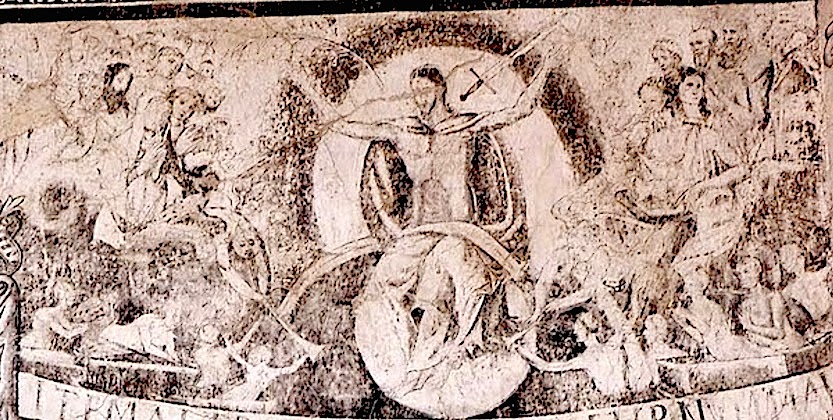
The Last Judgment, on the other hand, is tumultuous medieval drama. In the upper panel Christ sits in majesty atop a rainbow with sword and scepter among the massed ranks of the Blessed. A Latin banner proclaims the damnation of sinners to eternal fire while the dead struggle from their coffins.
Underneath, against a black background, the naked white bodies of the Damned suffer unspeakable torments: demons with grasping claw and gaping jaws tie their victims to trees, break them on the wheel and toss them into a steaming cauldron. Confronted with this nightmarish vision, who would not strive for salvation?
See our other posts on portrayals of the Last Judgment : Xoxoteco; El LlanitoTotimehuacanSuchixtlahuacaHuaquechulaYanhuitlanCuitzeoIxmiquilpan;
text © 2018 Richard D. Perry.  images by the author, Robert Jackson and others

Monday, April 23, 2018

Acolman: The Cloister Murals 1

There are two cloisters at Acolman: the smaller front patio, attributed to the Franciscans, and the grander rear cloister—an Augustinian addition. In this post we consider the murals of the smaller patio.
Dating from the 1530s, the front cloister is the smaller, plainer and darker of the two, its heavily buttressed arcades cut from black tezontle, as is the venerable cross in the center. Only the upper parts of the frescoes along the walks have survived the periodic inundations of the lower cloister. 
   The surviving frescoes, however, are later than the cloister itself, dating from the Augustinian period, circa 1560. They are broadly contemporary with those in the rear cloister and possibly by the same hand(s)  Outlined and detailed by a master draftsman in warm, sepia tones that reveal a powerful Flemish influence, all feature architectural backgrounds.
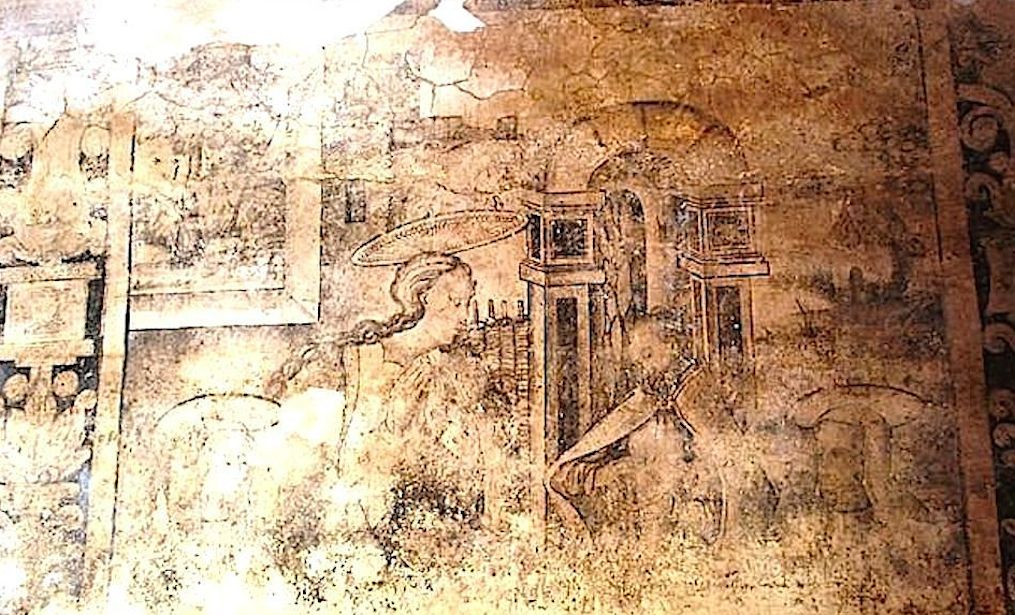
The Annunciation, witnessed by Saints Augustine and John of Sahagun
The four most complete corner frescoes are on the west side of the cloister and, rarely for cloister mural cycles, illustrate episodes from the Life of the Virgin Mary. 
   These comprise The Annunciation, The Visitation, The Nativity and a partial Adoration of the Magi. In each scene, except for the Magi fresco, two Augustinian saints, including Augustine and St. Jerome, witness the event from the lower corners.
The Visitation, witnessed by Saints Ambrose and Jerome
The Nativity (Adoration of the Child) with two female saints
Adoration of the Magi
Two other related but largely erased murals appear on the east walk of the cloister. Both are assumed to portray Marian themes, and again, pairs of saints observe the proceedings from either corner.


singing feline? and friar (images courtesy of Jim Cook)
All the narrative frescoes are framed by broad, bold grotesque panels with human and animal visages enmeshed in stylized foliage.
 
St. Ambrose and St. Jerome
  
Evangelists
Along the arcades, portraits of the four Evangelists, alternating with the four Fathers of the Church, cling to the inner faces of the corner piers, while Augustinian saints are shown on the intermediate ones.
text © 2018 Richard D. Perry
photography by the author, Robert Jackson, Jim Cook, & ELTB

Tuesday, April 17, 2018

Acolman: The Open Chapel fresco

 
Between the church and adjacent convento, a broad archway opens on the upper level, crowned by a plain, rectangular alfiz. This is the original open chapel, which may date from the Franciscan years at Acolman before 1540. From this raised balcony the friars would preach to the Indians assembled on the terraces below.
view from open chapel to terraces below
Restoration of this elevated chapel revealed a dramatic mural on the rear wall portraying St. Catherine of Alexandria, the patroness of preachers. Although appropriate to the Franciscans, it is not associated with any particular religious Order and seems likely to postdate 1540.
   Swathed in rippling robes, she is crowned, as a royal, and holds up an open book, a symbol of her erudition; the saint also holds an impressive sword—the instrument of her martyrdom. A fragment of her traditional wheel remains at upper right and at her feet, the severed head of her tormentor the Emperor Maxentius. 
text © 2018 Richard D. Perry
color images by the author and courtesy of Marina Hayman

Wednesday, April 11, 2018

Acolman: The Porteria murals

In our first post we looked at the frescoes inside the church at Acolman. In the next several posts we turn to the murals inside the adjacent convento, starting with the entry portería.

Unfortunately, no complete murals have survived inside the long, arcaded porteria at Acolman. The only remnant is a sprawling, if partial polychrome fresco across the end lunette, rendered in burgundy, turquoise and varied washes of earth colors. 
Sufficient vestiges remain to identify it as representing, among other elements, the Virtues, Prudence, Faith and Charity, as well as sins like Avarice, accompanied by other figures including friars and a partial Holy Trinity with the Virgin Mary, all afloat in a swirl of celestial clouds.
 
The Virgin Mary;                                             God the Father
The Virtues, detail
In the adjacent entry vestibule only the monochrome frieze remains above the painted doorway, elegantly inscribed with the Latin legend from Genesis:
 “How awesome is this place. It is none other than the House of God and the Gateway to Heaven.”  
Similar ornamental lettered friezes appear throughout the convento quoting in most cases from the Psalms and other Old Testament sources.
In addition, painted doorways and niches appear throughout the convento, including this colorful baroque wall retablo, portraying Augustinian friars.
text and images © 2018 Richard D. Perry