Wednesday, September 25, 2019

San Gabriel Cholula: two more early frescoes

In earlier posts on the exceptional murals at San Gabriel Cholula, we highlighted scenes from the life of St. Francis and a large Mass of St Gregory. Here we look at two other early frescoes of interest.
The Annunciation mural
The first is a fine, early triptych portraying the Annunciation, now located in an office on the second floor of the convento. 

Flanked by separate portraits of St. Francis and St. Anthony, the Virgin Mary, seated with an open book, receives the doves of the Holy Spirit, as the archangel Gabriel gestures towards Heaven—the only portrayal of its patron saint in the monastery to our knowledge. An urn of lilies, symbolizing her purity, stands prominently between the two.
The Baptism of Christ
The second fresco, a colorful Baptism of Christ is located in the old portal de peregrinos, now the Franciscan library, and was uncovered where the baptismal font may have been located during the early years of the evangelization. 
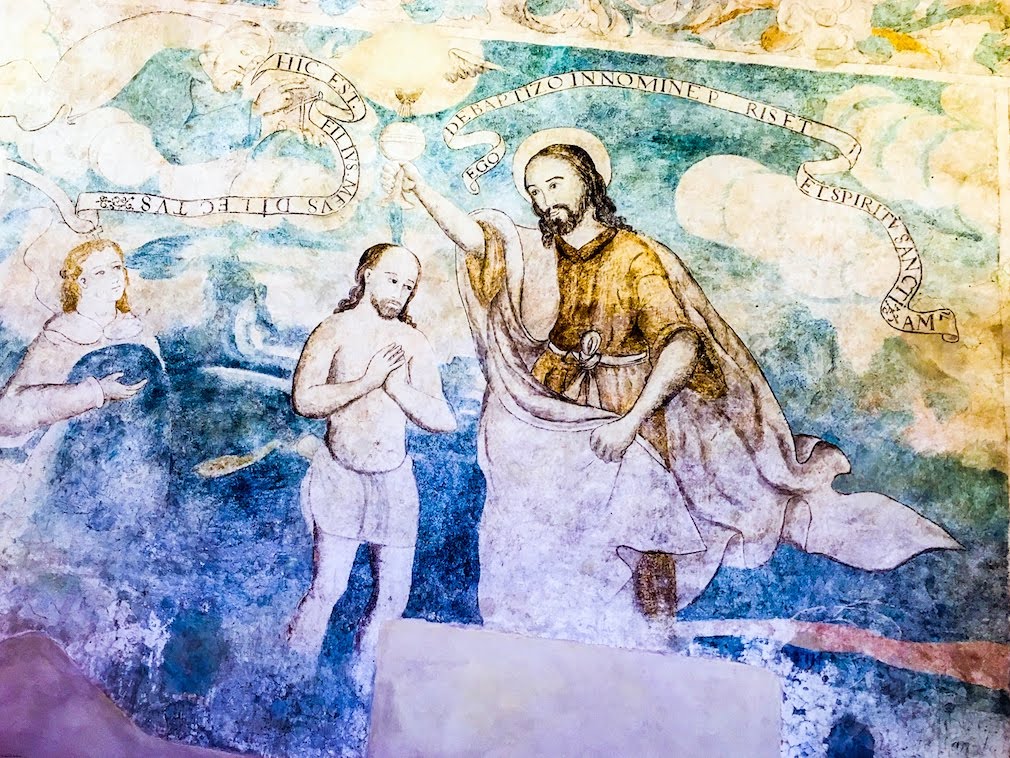
   A long Latin inscription unfolds in the ribbon above John the Baptist, who raises the baptismal chalice above the almost naked Christ. God the Father speaks from the clouds—"this is my beloved son in whom I am well pleased." 
   After restoration, its bright range of color, including putative Maya Blue, has reemerged.
text © 2019 Richard D. Perry
color images courtesy of Robert Jackson

Tuesday, September 10, 2019

The Charo Murals 3: The Refectory frescoes.

In the last of our three posts on the Charo murals we look at the remarkable Refectory Murals
The third great repository of mural painting at Charo lies in the high ceilinged refectory. The most recently uncovered, this extraordinary cycle of frescoes, some on rarely depicted subjects, extends around all four walls, showing a lighter touch and a more liberal use of color than the other Charo murals. 
The side walls of this large room are adorned with two tiers of panels, each framed by ornate painted pilasters, swagged borders and grotesque friezes.
Appropriately for a refectory, the principal panel on the end (west) wall depicts the Last Supper, in which white robed apostles with red hair lounge around a long table.  This is flanked by the related Feeding of the Five Thousand, as well as a Baptism of Christ.
   Beneath the Last Supper appears another portrayal of the Agony in the Garden, although less intense than the vestibule version.
Adoration of the Virgin and the Evangelists
A delicate fresco of the Adoration of the Virgin is painted beside the east wall, opposite the triumphal golden figure of the Archangel Michael wrestling with the Devil—the only portrayal of the patron saint to appear at Charo. 
The east wall is the most complex. An enormous but poorly preserved Calvary scene forms the centerpiece, flanked by portraits of the Four Evangelists, each seated pen in hand upon a throne with his identifying attribute. 
Located at lower right is a faded but dramatic fresco of Saul on the road to Damascus. In this scene, we see the dazzled future apostle being thrown violently from his frightened horse, as a reproach issues from Heaven on an unfurling banner. 
Finally, a cautionary mural appears above a window to the refectory. A lone friar clutching a large, red crucifix—possibly the young St. Augustine—is tempted by an angel on one side and the Devil on the other, both pointing to a scripture and holding out a quill holder and inkhorn—motifs we saw at Actopan. 
   Of the seven Augustinian monasteries of colonial Michoacán lauded by Fray Matias, San Miguel Charo far surpasses the grander priories of Cuitzeo and Yuriria in its mural decoration. It is to hoped that these historic murals, under threat from damp and water damage, will be speedily protected and restored for future generations.
Text © 2019 Richard D. Perry.
images by the author and courtesy of Niccolò Brooker and Robert Jackson.

Monday, September 2, 2019

The Charo Murals 2: The Cloister frescoes

For the second in our series on the Charo murals we consider the Cloister Frescoes
The cloister frescoes—some of them now only fragmentary—are the most dramatic at Charo, clearly designed to glorify the Augustinian order. 
 All the narrative panels are framed by painted Plateresque pilasters with lively grotesque friezes that incorporate sacred monograms and Augustinian emblems, linked by cornucopias, dancing cherubs and fantastical monsters—part dragon and part acanthus foliage.
Adjacent murals along the north walk illustrate the Spiritual Lineages of St. Augustine and his mother, St. Monica. Although such pictorial genealogies are not uncommon in mendicant monasteries, it is rare to find them paired in this way. 
Both murals use the classic medieval motif of the Tree of Jesse, in which a twisted tree rises from the chest of the now partly erased, reclining saint.  Along the spreading branches, birdlike Augustinian friars, nuns and prelates emerge from huge blossoms, each figure identified by an inscribed banderole, now generally illegible. 

The Genealogy of St. Monica is lighter and less crowded than that of St. Augustine, permitting more anecdotal detail. The black-robed sisters share their branches with a large crow? and numerous over-sized buds and pomegranates.
Along the south and west walls of the cloister, a sequence of dynamic scenes unfolds depicting the grisly fate of historic Augustinian martyrs. 
In graphic tableaux, deftly sketched in contrasting black and white tones, tonsured friars in black habits are variously speared or transfixed by arrows at the hands of brutal persecutors in white military togas.
Youths stone one stoic brother, while pious female onlookers sink to their knees in grief or prayer. Other meek friars are dragged one by one to their beheading, by a trio of muscular executioners under the merciless eye of a pagan potentate. (Calvary scene inset)
In another tableau, several friars stand in a giant cauldron atop a flaming fire, beside them a crowd of black robed Augustinians being set upon by their tormentors. The only other large cauldron appears in the Last Judgment mural at Acolman.
   Unfortunately, the murals that occupied the corner niches of the cloister have been erased, except for the single fragment of an Ecce Homo in the southeast corner, which may indicate that the Passion cycle continued from the vestibule into the cloister at one time.
The “Thebaida” mural
The remaining large mural along the east walk, although only partial, seems to represent the Eremitic Life—a reference to Augustinian beginnings in the desert hermitages and monastic communities of “Thebaida,” a remote province of Egypt.
Here, black robed friars engage in various activities against a wooded landscape.
   This favorite Augustinian subject was frequently illustrated in the monasteries of the New World, where their missionary enterprise was viewed as a religious undertaking of equal significance to the early history and expansion of the Order—a theme embroidered by Fray Matías de Escobar in his baroque treatise Americana Thebaida, where he compares the seven Augustinian monasteries of Michoacán to the seven legendary pyramids of Egypt, and praises the architectural and spiritual harmony of Charo, where he once served as a well loved prior.

Text © 2019 Richard D. Perry.
images by the author and courtesy of Niccolò Brooker and Robert Jackson.

Tuesday, August 27, 2019

The Charo Murals 1: The Passion Cycle

Following Cortés' defeat of the Aztecs in 1521, the native Matlatzinca nobles of what is now northeastern Michoacan joined the Tarascan king in declaring themselves vassals of the Spanish emperor and expressed their willingness to convert to Christianity.
   In 1528 or 1529, Fray Juan de San Miguel visited Charo to baptize its leaders, who honored the distinguished Franciscan missionary by adopting the Archangel Michael as their patron saint. 

   The Franciscans however failed to establish a permanent mission and in 1550 Bishop Vasco de Quiroga ceded Charo to the Augustinians, provided that they build a monastery there.
Soon afterwards, Fray Pedro de San Gerónimo OSA arrived to congregate the Matlatzincas of the area into a traditional mission town with several barrios and a centrally located priory.

Fray Pedro chose a commanding hilltop site for the mission, and planned the new building down to the last detail. He is even credited with directing its extensive mural program—the principal glory of Charo.
The Murals
The frescoes at Charo are the most complete and thematically diverse in Michoacán, and rank among the finest suites of 16th century murals to survive in Mexico. Entirely executed in burnished fresco secco, the murals feature the flowing outlines and sharply drawn details characteristic of monastic wall painting in Mexico, clearly revealing their source in European religious prints and book illustrations—at that time the only graphic sources readily available to the friars and native artists.
   Painted by different hands at different times, the predominantly black and white murals are accented by flesh tones, blue and rose accents, with earth colors of ocher and burnt sienna. They fall into three main groups: the Passion cycle in the entry vestibule; the narrative cloister murals; and the extraordinary frescoes of the “refectory” or sala capitular?.
   We begin our series of posts on the Charo murals with the Passion cycle in the entry vestibule:
Entry porteria

The Passion Cycle 
Beyond the elegant arcaded portería, the anteporteria or narrow inner vestibule leads to the cloister. The scenes of Christ's Passion that line the walls of the vestibule are the earliest and most conventional of the murals in their themes and composition.
   The principals in the Passion drama, awkward in their heavily outlined robes, are posed in medieval landscapes of wooded hillsides and turreted buildings. 
Four main panels—the Agony in the Garden, the Kiss of Judas, the Flagellation and the Mocking of Christ—line both sides of the passageway. 
The Agony in the Garden
The Taking of Christ (Kiss of Judas)
The Flagellation
The Mocking of Christ (detail)

The Crucifixion is set in a busy landscape of hills, trees and turreted buildings, and is dotted with sun, moon and indigenous cactus-like plants. As elsewhere, significant details—the cross, hands, faces and the moon—are tinted in ocher and reddish brown.

Text © 2019 Richard D. Perry.
images by the author and courtesy of Niccolò Brooker and Robert Jackson.

Wednesday, August 21, 2019

Yucatán: The Motul Murals

On the north side of the neoclassical church front at San Juan Motul, an arcaded porteria gives access to the cloister, where repair work has led to the uncovering of fragmentary but colorful colonial murals there. 
   Although incomplete and at least partially erased, the subjects of these murals are extremely unusual, and in fact unique in Yucatán:
The Star Clock
Thought to date from the late 1700s, this unusual fresco in the upper cloister at Motul features a clock-like calendar wheel outlined in red, blue and ocher, set within a square frame of grotesque floral decoration. 
   In a variation of the wind compass, or rosa de vientos—a motif popular at that time—a head with a feathered tiara caps the circle at the top, while hands and feet protrude from the sides and bottom.
Personified winds, in the conventional pictorial style of early maps, blow in from the four corners of the frame. Spokes or arrows in red and blue penetrate the circle from these points, dividing it into eight pie-like sections, each of which is further marked into three additional sections on the outer circle—a total of 24 in all. 
   Signs for the months of the year are then inscribed around this outer circle, each month occupying two divisions. At the center of the circle is a white star with a star-spangled, comet-like tail, thought to represent the pole star, and above it a plume emblazoned with stars probably signifying the constellation Ursa Minor. 
   Given the presence of the pole star and the constellation, it is probable that this device functioned both as a star clock and an astronomical calendar. Together with an exterior sundial * to measure the daylight hours, this chart would have enabled the friars to ascertain the nocturnal passage of time—essential in determining the liturgical hours. 
   It seems likely that, in coordination with its astronomical component, this fresco was also designed as a visual map of seasonal events and changes, with the head, hands and feet indicating the solstices and equinoxes, and the four winds marking the divisions between spring, summer, autumn and winter—measurements of critical importance in the agricultural round.
 
While the graphic sources for this mural remain uncertain, one point of origin may be the nautical manual, Instrucción náutica para el buen uso y regimiento de las naos, su traza y gobierno conforme a la altura de México, published there in 1587 by Diego Garcia de Palacios. 
   Although a few rare pictorial representations of this device are known from early colonial documents, this is the only known mural of the subject in Mexico.
color image courtesy of  Susan V. Webster 

Other Murals 
During alterations to the cloister, other large mural fragments came to light beneath layers of whitewash. These brightly hued polychrome frescoes apparently portray hunting and genre scenes, and may be late 17th or 18th century in origin. 
   It is to be hoped that further systematic research can be carried out to recover and conserve these irreplaceable colonial murals. 
text © Richard D. Perry
with acknowledgments to Susan V. Webster, M. en Arq. Antonio Rodríguez Alcalá  and William Taylor

Saturday, August 17, 2019

San Juan Evangelista Culhuacan: The Convento Murals 2

The Upper Cloister
Around the upper cloister at Culhuacan, large Renaissance murals of the Life and Passion of Christ are interposed with medieval style portraits of Augustinian saints and martyrs, most generally in better condition than those below. As distinct from the others, this group is painted in traditional grisaille, with little added color, and framed by Renaissance style grotesque panels. 
Located at the top of the stairs is a partial Entry into Jerusalem with Jesus mounted on his donkey, the figures of the Apostles and a crowd throwing palm leaves. 
In the southwest corner is an elegant Nativity with the Adoration of the Magi, the most complete of the compositions.  
    The Holy Family is calmly posed on the left. with lowered eyes, set in a surprisingly well appointed structure of uncertain perspective. The three kings stand on the right, two standing and one kneeling, while their three horses prance on the extreme right.  
   The star of Bethlehem hangs in the center above a prominent hill, again evoking the sacred local landmark of the Cerro de la Estrella, site of the Aztec New Fire ceremony.
Rows of martyrs line the south walk. These include a partial St. Stephen, then St. Dennis holding his severed head, and St. Nicholas of Tolentino, the prominent Augustinian preacher and healer, wearing an expression of beatific calm despite the loss of his severed right foot and left hand.  
   Numerous other Augustinians, obscure and notable, are portrayed on the pillars of the cloister arcades, including such luminaries as John of Sahagún, and lesser known figures like Blessed Amadeus of Savoy.

In the middle of the same corridor, an inscribed panel of the company of Augustinian martyrs is set in an elaborate painted Plateresque frame. Clutching their books and palms, the martyrs crowd into the foreground, their rows of tonsured heads shining like peas in a pod.
There is also a partial portrayal of the Augustinian African martyrs in a cauldron; the only other version being that at Charo.
The prior's room, on the upper western corridor adjacent to the church, is identified by its paneled wooden door carved with the Augustinian pierced heart and other symbols associated with the Order and the Passion of Christ. As with the other friars’ cells, it retains many of its original friezes in the same grotesque style, with fruits, flowers, birds, putti and fantastic beasts.
text ©2019 Richard D. Perry.
images by the author, Niccolo Brooker, Diana Roberts & Robert Jackson

Friday, July 5, 2019

San Juan Evangelista Culhuacan: The Convento Murals 1

The Culhuacan map of 1580 by Pedro de San Agustín, with church and place glyph of sacred mountain with cave and spring.

The rugged Augustinian monastery at Culhuacan is hewn from coarse black lava. The roofless basilican church and its brooding convento convey the same timeless monumentality as the surviving Aztec structures scattered throughout the valley. The complex has undergone structural changes over the centuries—the old church collapsed and a new one built late in the colonial period.

Although some were lost to the reconstruction, neglect and ill considered, later over painting, and while many remain only fragmentary, the bleak convento is brightened by numerous 16th century frescoes in a mixture of styles and coloration. Executed al temple, or in fresco de secco— paint applied to dry instead of wet plaster—they picture a wide range of themes dear to the Augustinian Order.

Anteporteria
Beyond the L-shaped porteria, the vestibule (anteporteria) is decorated with a faded Ship of Friars mural thought to depict the arrival of the Augustinians in the New World. The murals in this room are painted in traditional warm black, with faded blue and umber details. 
The principal fresco, framed by painted baluster columns, is a triptych of a stylized St. Augustine, with crozier and miter, holding up the church, and depicted as Protector of his Order. He is flanked by black clad friars on either side beneath his spreading cloak, and in a reference to the other mendicant Orders, St Dominic stands to one side and St Francis receives the Stigmata on the right.
St Dominic
The Lower Cloister 

Thebaida with Calvary scene above arch 
The lower cloister murals are framed in the same style, but rendered in still glowing colors against an unusually bright azure background, possibly water related. 
   At least two of the walls depict the Augustinian Thebaida, or Allegory of the Eremitic Life— portrayed here as an Earthly Paradise. Against an idyllic landscape of rocks, hermits’ caves, lakes and native vegetation, groups of tiny friars pursue their tasks in a peaceable kingdom of naively drawn felines, rabbits and deer. 
More than merely decorative, the landscape mirrors the topography of the area as portrayed in the Culhuacan map, notably the distinctive local mount of Cerro de la Estrella with its cave and springs, sacred to the ancient Culhuas and the Aztecs as the site of the annual New Fire ceremony.  
   In fact, the Thebaida artist and the painter of the 1580 map (see above) may have been one and the same—possibly one Pedro de San Agustín, an elite tlacuilo from Tlatelolco and thus one of the few native muralists whose name has come down to us. 
   These large scale frescoes, which may have originally covered all of the cloister walls, are again framed by ornate, faux baluster columns and inset with medallions showing scenes from Christ’s Passion—an impressive and colorful gallery.  

Detailed and colorful grotesque friezes above the murals add to the intensity of the display. Numerous apostles, evangelists, saints and martyrs appear in large cartouches throughout— predominantly in blues, reds and earth hues— set in a matrix of foliage, angels and pegasi:
St. Augustine                                           St. Mary Magdalene 
St. James Major                                                                Martyr. Nicholas of Tolentino? 
St Lawrence                                              St Sebastian
By the stairwell, an enigmatic mural shows two friars—one reading a book and the other gazing up the stairs in an attitude of prayer. Birds fly above, with a steep hill behind. 
text ©2019 Richard D. Perry.
images by the author, Niccolo Brooker, Diana Roberts & Robert Jackson