Monday, February 12, 2018

The Malinalco murals 2: the Paradise Garden Murals

From the portería at Malinalco it is only a few steps to the arcaded two story cloister. As with the entry portería, the walks are barrel-vaulted except for the corner compartments which are covered by Gothic ribbing.
Like the portico, the inner faces of the piers at one time bore painted portraits of Augustinian saints and martyrs, of which only two indistinct corner murals —a bishop and a friar—survive.  The only other distinctive remnant, in a side niche, is a painting of a friar confronting the Grim Reaper.
Painted in the 1570s and hidden beneath multiple coats of whitewash until the mid-1970s, the famous corridor murals are mostly well preserved, although those on the west side have been partly erased. Recent restoration has imparted a new brilliance to the frescoes that by some accounts may have obscured some of its original subtleties. 
The "Garden" murals
The corridor frescoes surround the lower cloister on all four sides, contained within broad, running friezes consisting of bands of foliated decoration.

   In traditional Augustinian style, these friezes enclose a long Latin inscription from the Psalm 84, spelled out in ornamental orange letters against a black background:

"My soul yearns, even faints, for the courts of the Lord; my heart and my flesh cry out for the living God. Even the sparrow has found a home, and the swallow a nest for herself, where she may have her young—a place near your altar, Lord Almighty, my King and my God.!
Blessed are those who dwell in your house; they are ever praising you. Blessed are those whose strength is in you, whose hearts are set on pilgrimage.As they pass through the Valley of Baka, they make it a place of springs;!"
Cacti, with IHS medallions and rat
Boldly sketched in warm monochrome, leavened with accents of greenish-gray, the main murals constitute a continuous tapestry or frieze of twisting vines, trees, grasses and flowers featuring native American and Old World flora and fauna—birds, animals and insects—enveloping and linking large, armorial medallions of Augustinian insignia and intricate Christic and Marian monograms, which stand out from the floral background like mystical talismans.
Adam and Eve in a tree
Unlike most other Mexican cloister murals, with the exception of a miniature Adam and Eve, no human figures appear in the garden sequences, nor is there any other narrative theme.

"song scroll"
Although the design elements are drawn from Islamic and European graphic sources, the execution of the frescoes is indisputedly the work of native artists or tlacuilos, who were skillful observers of the natural world and who, almost fifty years after the conquest, still retained detailed knowledge of pre-hispanic customs and beliefs. In fact, the slotted "song scroll"—the telltale signature of the tlacuilo—appears at intervals in the murals on the vault. 
 
serpent, deer, rabbit and birds
  
coatimundi, feline and birds
Many of the native plants and animals shown certainly had special meaning for the indigenous viewer. Other significant symbols, perhaps unrecognized, may lurk amid the rich jungle of twisting foliage.
The Cloister Ceilings
Unlike the geometric designs above the portería and upper cloister, the ceilings here complement the wall frescoes, 
alive with restless, acanthus like foliage with varied blossoms and clusters of grapes. In contrast to the walls, no birds or animals appear although song scrolls are everywhere.
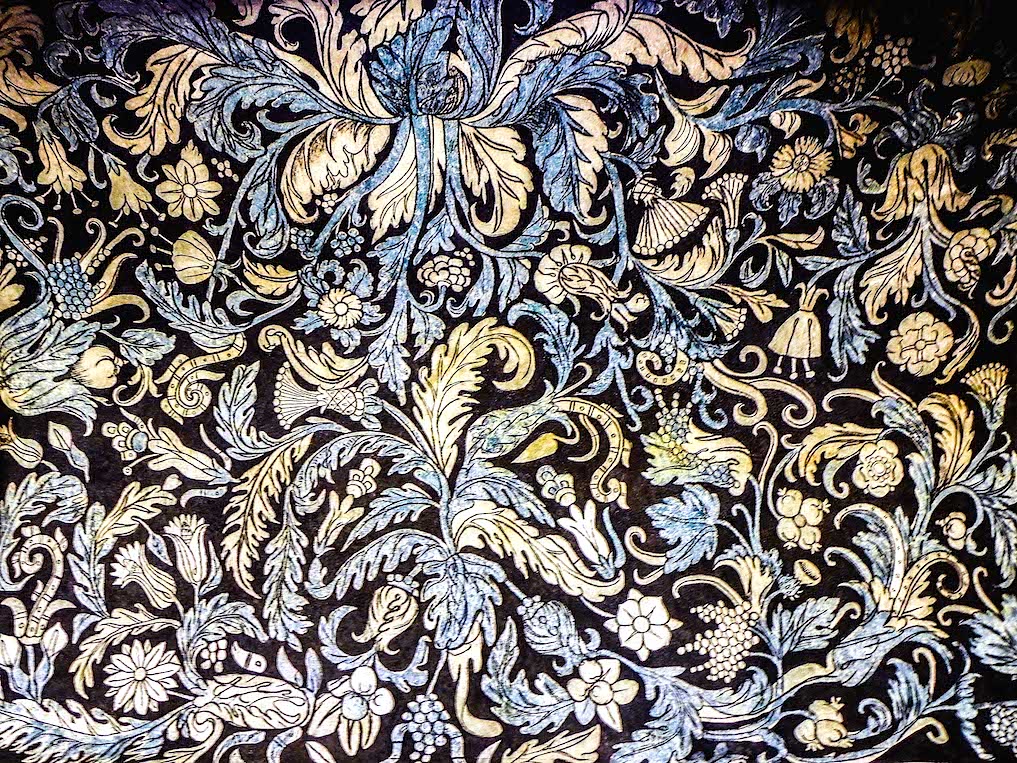
Predominantly painted in blue and orange tones—colors of important prehispanic significance—they are executed in a different hand, evincing a more indigenous approach with heavier outlining of objects and a writhing, almost abstract patterning of the foliage. 

Interpretations
Scholarly views of this unique mural program vary. The best known i
nterpretation is that the murals represent and visualize the utopian Paradise Garden. This theme is reinforced by the inclusion of plants and animals that traditionally symbolized sin (serpents and monkeys) and redemption (butterflies and doves), reiterating the medieval monastic view of a civilized and Christian world in constant conflict with untrameled Nature and the disordered domain of the Devil.   
   Others view the exuberant profusion of native flora and fauna, at least covertly, as a joyous, even musical paean to the prehispanic world of the sacred, recreated in the Christian sphere.
   In another view, the frescoes imply the favored Augustinian theme of the Eremitic Life or Thebaida. This subject was rooted in their cenobitic origins and elaborated upon during their later expansion as an apostolic order. It extols the Christian message, conveyed by the friars to bring order and enlightenment to what they viewed as the vast pagan wilderness of the New World. 
   In any event, the visual superimposition of Christian and Augustinian emblems upon Nature implied that the imposition of such order and enlightenment was possible only through the Augustinian Order, a theme made more explicit in the portería. 
   The prominent display of Marian emblems embedded in the depictions of luxuriant nature, draws attention to another aspect of 16th century mendicant thought, in which the enclosed cloister also serves to symbolize the Hortus Conclusus, and by extension the inviolate nature of the Virgin Mary herself.

SOURCES:
Peterson, Jeanette,  The Paradise Garden Murals of Malinalco: Utopia and Empire in Sixteenth-century Mexico, Austin, University of Texas, 1987.

Peterson, Jeanette “La flora y la fauna en los frescos de Malinalco: paraíso convergente” 

en Iconología y sociedad. Arte colonial hispanoamericano. XLV Congreso Internacional de Americanistas, México, UNAM-IIE: 23-42 pp.  1987

Estrada de Gerlero, 
Elena Isabel, “Malinalco. Orígenes de su traza, convento y capillas”, en Malinalco, imágenes de un destino, México, Banca Cremi, 1989 

RUBIAL GARCÍA, ANTONIO,  Hortus eremitarum Las pinturas de tebaidas en los claustros agustinos

Wake, Eleanor,  Framing the Sacred  University of Oklahoma Press  2010


text © 2018 Richard D. Perry. color images courtesy of Robert Jackson and Carolyn Brown

Monday, February 5, 2018

The Malinalco murals 1: the Porteria

San Salvador Malinalco
The Augustinian priory of San Salvador Malinalco played a key role in the evangelizing and missionization of Michoacán and western Mexico. In the 1540s the Augustinians took over a humble Franciscan mission and began work on a new monastery using stone from demolished Aztec temples—a grand project only completed in the 1570s.
The imposing scale of the priory and its convento was matched by its murals, which covered almost every surface—walls, ceilings, doorways and niches. While some have been lost to time and neglect, a substantial remnant has survived and recently undergone extensive restoration.
The Portería murals 
Although the frescoed lower cloister is the star attraction at Malinalco, which we review in our next post, we begin our exploration of the murals with those in the entry portería.
   Blocked up and thus protected from the elements until recently, this arcaded entry of seven bays, has been newly restored. The vaulting displays a complex, geometrical artesonado design, painted in bright red hues and incorporating medallions displaying Augustinian insignia.
More significantly, the porteria murals immortalize the first seven apostolic Augustinians to arrive in Mexico in 1533. Originally, all seven friars were portrayed on the inner faces of the seven arcade piers, together with their names. 
Fray Agustín de La Coruña
Fray Alonso de la Vera Cruz
Only two of these now partial portraits remain; one of them is of Fray Alonso de la Vera Cruz, "El Venerable," the leader of the first Augustinian contingent, and the other Fray Agustín de La Coruña, later Bishop of Popayan in Colombia
A dated inscription in Spanish describes the arrival of the Augustinians in Mexico and the founding of Malinalco: 
"These are the seven religious who came to preach the gospel in the year 1532, the Emperor Charles V being king and the Pope Clement the 7th and the General of our Order, Fr. Gabriel de Veneto, Provincial of Castile Fr. Francisco de Nieva and the Viceroy Don Antonio de Mendoza. This convento was founded in the year of 1543."

text and graphics © 2018 & 1992 Richard D. Perry. 
color photography by the author and online sources

Wednesday, January 31, 2018

San Juan Teitipac: the Last Supper

San Juan Teitipac church front and convento entry
In our earlier posts on Teitipac we looked at the murals in the portería of the convento: the processional frescoes on the south wall and those of the Virgin of the Rosary on the north and east wall.
   Before the tragic destruction of the cloister, many of its walls were also decorated with murals, most of which have been lost. However, vestiges remain of some early examples in what is left of the former refectory, notably an extraordinary Last Supper fresco on the rear wall.
   For many years open to the weather, this mural has been largely washed away, save for some outlines and partial portraits of Christ and the Apostles, originally painted in a warm monochrome.
the Last Supper in 2005
Nevertheless, from these surviving fragments, we can still appreciate the refined draftsmanship, most noticeably in the sensitive treatment of the faces of the Apostles.
While the recent installation of a beamed roof on the room provided some protection, the repair work unfortunately contributed to the further damage to the mural, all the more of a loss since, unlike the portería frescoes, its unrestored state reveals the original skill of the anonymous native muralist.
the Last Supper in 2008
text and color images © 2018 Richard D. Perry. 

Friday, January 26, 2018

San Juan Teitipac: the North Wall murals

In our first post on the Teitipac murals, we described the dramatic sequence of 16th century processional frescoes adorning the south wall of the two-story vestibule just inside the entry portería. 
   These well known frescoes have attracted much commentary, but in this post we consider the largely ignored group of murals opposite, on the north wall of the portería.
The north wall frescoes: west to east
The North Wall frescoes
This cycle comprises three large scale murals. Although partially erased and still largely unrestored, as we shall see, they do not relate to the processional frescoes opposite. 
The center panel of the triptych illustrates the Annunciation of the birth of John the Baptist, the patron saint of the monastery.  A richly robed, kneeling figure, identifiable as the priest, prophet and father of St. John, Zechariah, waves a censer at an altar emblazoned with a large foliated cross. 
   A now partial San Gabriel rises in a cloud above the altar to announce the divine conception of John the Baptist to the incredulous Zechariah. 
An awed group kneel in prayer from the doorway of an adjacent temple.
The adjacent panel, nearest the west entry to the vestibule, is the least well preserved, although the details are fairly well outlined. 
   Here the event is the actual birth of John the Baptist. The hazy figure seated on the left again is the now mute Zacharias holding a book.  Above him, an attendant brings towels or warm water. 
The figure lying in the canopied bed above right is St. Elizabeth, the mother of John, while below, the infant, crowned with a halo, is held by the Virgin Mary amid a group of female attendants. 
The Dominican emblem of the foliated cross appears once more on the base of the center column.
The dramatic easterly panel, the best preserved of the three, portrays a reported dream of St. Dominic in Rome.* Christ sits in Judgment on a celestial cloud brandishing three arrows representing Famine, War and Pestilence—considered divine punishments for Pride, Avarice and Lust.
 
On the left, the Virgin Mary (standing) intercedes on behalf of St. Francis and St. Dominic who kneel, arms outstretched, below. 
Sun, moon and stars light the sky above Mary, and flames leap from the gaping mouth of Hell on the lower right. 
* Dominic was puzzled by the humble figure beside him in his vision. The following day he met Francis and realized that he was the person in the dream.
text © 2018 Richard D. Perry
photography © courtesy of Niccolò Brooker.  All rights reserved.

Sunday, January 21, 2018

San Juan Teitipac. Our Lady of the Rosary

In our previous post we considered the processional murals on the south wall of the portería vestibule at Teitipac. 
The east wall, with the Virgin of the Rosary (l) and the Deposition (r) 
In this post we look at the other fresco on the east wall, beside the Descent from the Cross. 
Adoration of The Virgin of the Rosary
The subject of this mural is the Presentation of the Rosary by the Virgin Mary to St. Dominic, or Adoration of the Virgin of the Rosary.
 
St Dominic and his dog
Here, the partially effaced figure of Our Lady of the Rosary is raised on a crescent moon amid swirling celestial clouds. Large, dark rosary beads descend on either side. 
   Below are the kneeling figures of St. Dominic on the left, holding the rosary and accompanied by his red collared Dominican dog, and to the right, a Dominican nun in the same posture—probably St. Catherine of Siena.
St Catherine of Siena
As with the north wall murals, a plaque representing the foliated Dominican cross lies beside the saint, below the feet of the Virgin.
------------------------------
text © 2018 Richard D. Perry
color photography © Niccolo Brooker

Wednesday, January 10, 2018

San Juan Teitipac: the Processional murals

In the 1570s, San Juan Teitipac was the dominant Dominican mission in Oaxaca's Tlacolula Valley, with four resident friars. Built atop an ancient Zapotec cemetery*, its vast atrium, with four corner posas, fronted the large cruciform church—a rarity in rural Oaxaca—and an imposing convento.
  While there are colonial treasures in the church, Teitipac’s chief claim to fame for visitors and scholars alike is the 16th century frescoes in the convento. This is the first of three posts on these early murals.
San Juan Teitipac
The Processional Murals
An arched portería on the south side of the church marks the entrance to the once substantial convento, of which little now remains. However, the two-story vestibule just inside the entry is a gallery of frescoes that include a dramatic sequence of processional murals in two tiers. These frescoes, which represent a reenactment of Holy Week ceremonies, were almost certainly sponsored by a local cofradía or religious brotherhood of the Santo Entierro, or Holy Sepulcher. 
view of the porteria and murals
Processional murals are exceedingly rare in Mexico—the only other examples being those in the church at Huejotzingo and the upper cloister at Huaquechula—both in Puebla and also painted at the behest of a local cofradía
   Recently partially restored, the Teitipac frescoes are painted in somber hues, predominantly cool black and earth colors with some red accents. 
The east wall of the porteria
Their position here in the convento entry—unique among the placement of such murals in Mexico—together with their depiction of actual doorways, suggest that the portería itself played a key role in early colonial ceremonies at Teitipac.
Descent from the Cross - detail
The sequence starts from a large, fairly well preserved Descent from the Cross, painted above the inner doorway on the east wall. Dominican friars, an unorthodox depiction for this scene, lower Christ’s body from the cross—painted bright red along with the accompanying ladders.
  
Virgin Mary and St. John;       Deposition from the Cross, engraving by Marcantonio Raimondi  (c. 1470 - c. 1527)
A poorly preserved Virgin of Sorrows and St. John the Evangelist look on from the sidelines. The overall composition is adapted from a popular print by the Italian engraver Marcantonio Raimundi.
south wall

Two tiers of processional scenes unfold along the south wall. 
south wall. lower tier
Below, a funeral cortege of Dominican friars proceeds westwards from a faux painted doorway, solemnly bearing aloft the body of Christ, accompanied by Mary Magdalene and assorted Spanish dignitaries and indigenous women. All the participants are boldly and realistically drawn with special attention to costume and facial expression. 
  
painted doorways: lower tier;  upper tier
south wall. upper tier (detail)
Along the upper tier, ghostly, hooded penitents in long, trailing robes walk in the opposite direction, holding candles, banners and various instruments of the Crucifixion, heading east 
towards another painted entry/exit. 
 
The recently cleaned murals on the north wall of the portería revolve around the Virgin Mary, the best preserved of which depicts the figure of Our Lady of the Rosary, a popular Dominican devotion, on the east wall—the subject of our next post.
* It is tempting to speculate that the obvious importance of this cofradía, a native brotherhood dedicated to the Holy Sepulcher, may be linked in some way to the prehispanic history of the site. 
text © 2018 Richard D. Perry
images by the author, Niccolò Brooker and Felipe Falcón

Wednesday, January 3, 2018

Colonial Mexican Murals

This month we mark the first anniversary of our specialized blog devoted to colonial Mexican mural art.
In addition to this past year's 51 posts (see sidebar) here are links to several earlier mural posts that appeared on our sister site:

Dzidzantún (Yucatán) 1 of 3
Epazoyucan (Hidalgo)
Metztitlan (Hidalgo)
Tepeji (Hidalgo)
Tepeapulco (Hidalgo)
Tlalmanalco (Edomex)
Tula (Hidalgo)
Tzintzuntzan (Michoacán)
Yecapixtla (Morelos)
Zempoala (Hidalgo)

Enjoy!  Richard Perry